Black Cat Superstition: What Is Myth and What Is Fact?

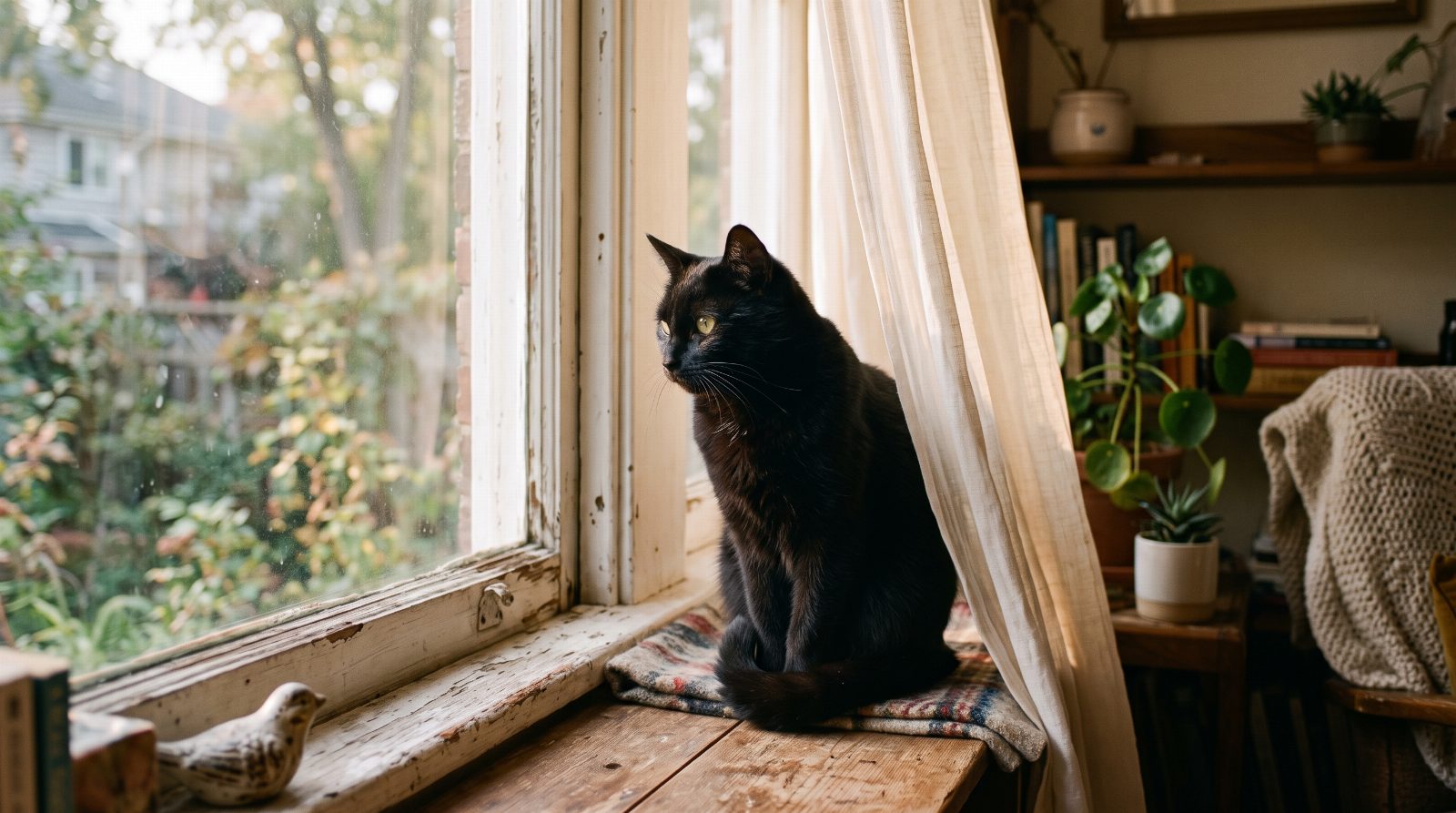
A black cat crosses your path and, just for a second, you think “please, nothing bad today”. Do you get the feeling your cat knows you are upset before you have said a word? Does she walk straight up to some guests and vanish under the sofa when others arrive? And does she sometimes purr in a way that has you on your feet and heading for the bowl?
You are in very good company. Few animals have inspired as many stories as the cat.
At Canefelis we prefer numbers to big words. So we are doing something slightly unusual here. We take the old stories seriously, then check what has actually been observed. The result is surprising. A lot of the superstition simply does not hold up. And what cats really can do is stranger than the superstition ever was.
You will find out where the black cat myth comes from and how much of your mood your cat picks up. Why purring does not always mean contentment. And what a sudden change at the food bowl can be telling you.
- A black cat brings neither luck nor bad luck, but superstition still shapes human choices.
- Cats read voice, face, scent and routine, not thoughts.
- Purring can accompany comfort, expectation or distress and is not reassurance by itself.
- Coat colour does not determine personality; human expectations are better documented.
- Sudden changes in behaviour, appetite, eyes or coat deserve veterinary attention.
Why cats have been considered magical for centuries
Cats have lived alongside us for thousands of years without ever quite belonging to us. A dog looks at you and wants something from you. A cat looks at you and you are not entirely sure who is observing whom.
There is more to it. Cats are more active at night than we are, they hear higher frequencies, they see in far less light, and they react to things we have not noticed yet. An animal that startles before you hear the doorbell looks like an animal that knows more.
That is exactly where myths are born. Not out of stupidity, but out of a correct observation paired with the wrong explanation.
Black Cat Superstition: Where Did the Ideas About Luck Come From?
Black cat superstition did not grow from feline behaviour. It grew from changing religious and regional stories. A church document from 1233 linked a black cat to an alleged ritual. Later traditions turned that image into contradictory signs of luck and misfortune depending on place.

In the early Middle Ages the cat was not a bad omen in Europe. She was useful, in places even revered. The turning point came in the 13th century.
On 13 June 1233, Pope Gregory IX issued a document titled Vox in Rama (“Voice in Rama”). It was prompted by reports from the inquisitor Konrad von Marburg about an alleged sect in Germany. In those reports, most of them produced under torture, a black cat appeared as part of a ritual.
Suddenly the idea that black cats had something to do with evil carried official backing. In the public mind, an ordinary household animal turned into a suspicious creature. Over the following centuries, and especially during the witch trials, a black cat in the house could become a piece of evidence against a woman.
The direction the cat comes from is a much later embellishment, and it varies completely from region to region. In some places she brings bad luck from the left, in others from the right. In Japan and in parts of Britain the black cat is a bringer of good fortune instead.
If the same cat means bad luck in one village and good luck in the next, the superstition is telling you something about the village, not about the cat.
How Black Cat Superstition Still Affects Cats Today
Old superstition can still influence how people judge black cats in photographs and shelters. Some datasets show poorer adoption outcomes, while others find small or no differences. What is certain is that coat colour gives no rational reason to overlook an individual cat.
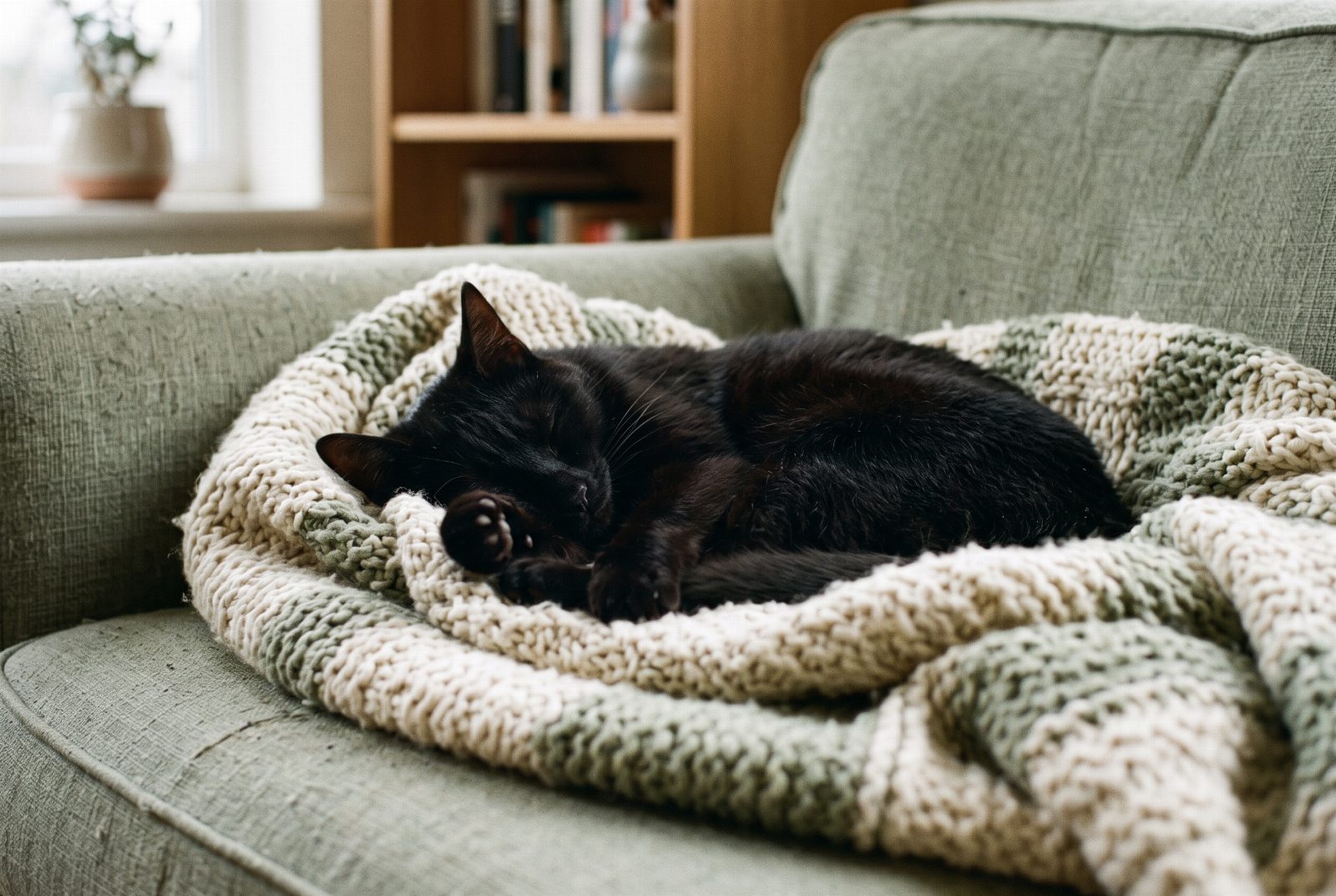
Shelter data keeps showing the same pattern. Black cats wait longer for a home than cats with lighter or mixed coats. In one analysis, adult black cats took around three days longer than black and white cats, and two to six days longer than cats of other colours. Across several sets of records, black cats had the lowest adoption rates in the whole group.
Why? Two reasons come up. First, the old superstition, still sitting somewhere at the back of some people’s minds. Second, something very practical: a black face is harder to read in a photo. Eyes, whiskers and expression disappear into the dark coat. One study found that the people who could not judge a black cat’s facial expression were also the ones who rated her more negatively.
So a misunderstanding from the 13th century plus a bad photo can cost living animals extra time in a shelter today.
If you are thinking about taking in a cat, give the black ones a proper look. Not out of pity, but because there is a good chance they were passed over for no reason at all.
Adopting a Shelter Cat: What Helps in the First Weeks
A new home changes scents, sounds, people, feeding times and hiding places all at once. A cautious cat is not ungrateful or mysterious. She is collecting information and looking for predictability.
- Start with one quiet room and let the cat choose when to explore.
- Keep food, water, litter and resting places stable.
- Offer hiding places and raised positions without pulling her out.
- Introduce people, rooms and other animals gradually.
Appetite, toileting, movement and social contact may change during adjustment. If the cat stops eating, appears painful, vomits repeatedly or shows another marked change, contact a veterinarian rather than assuming she only needs more time.
Does my cat know when I am sad?
A cat does not recognise sadness as a thought or diagnosis. She can notice changes in voice, face, posture, pace and scent. In experiments, many cats used their person’s reaction as information. This can explain approach or withdrawal without invoking telepathy.
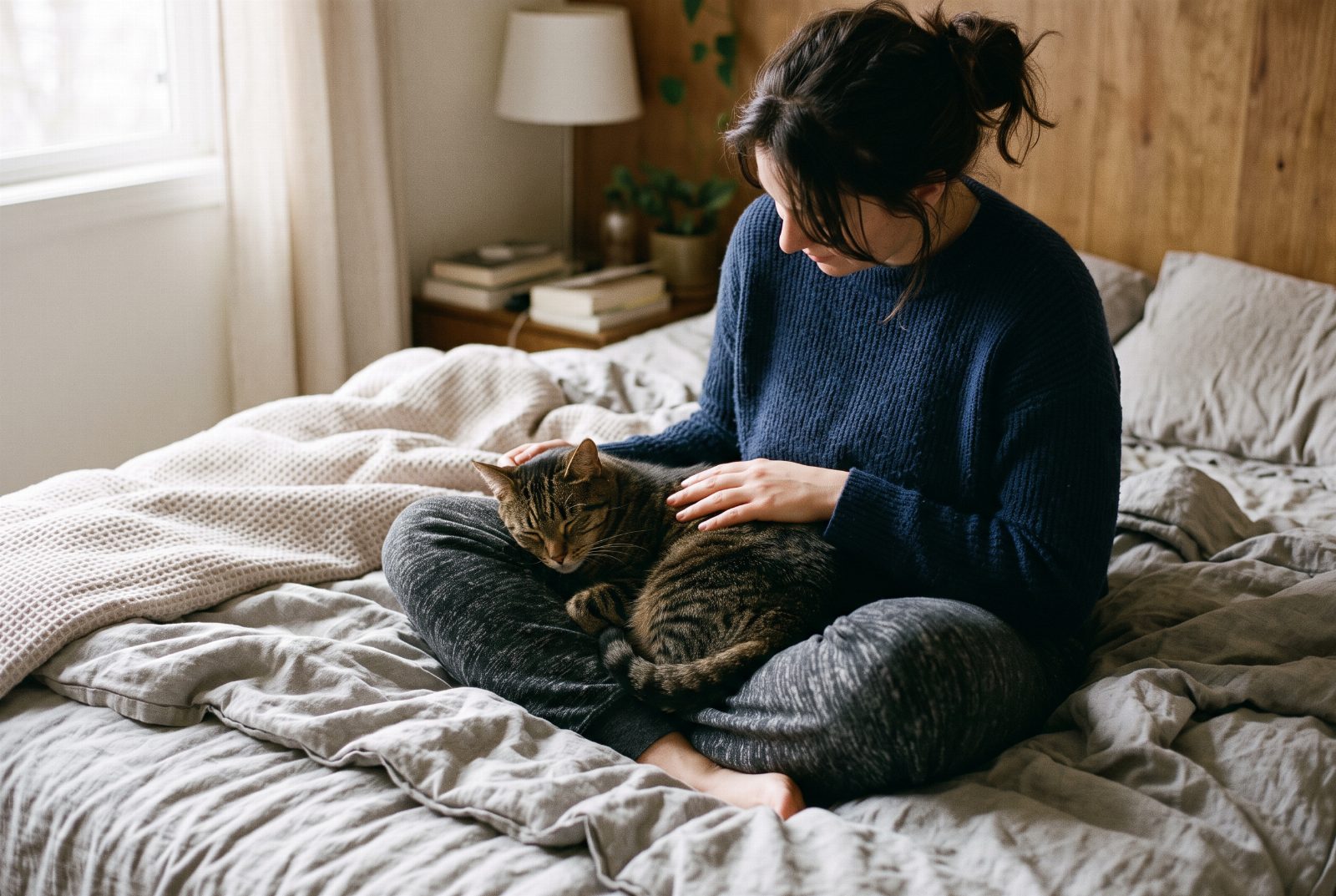
Cats read us. Not telepathically, but through signals they watch very closely: posture, tone of voice, how fast you move, facial expression, breathing rhythm, smells. When you are tense, you change in measurable ways, even if you do not notice it yourself. You walk faster. Your voice flattens. You pick things up differently.
There is a study that captures this nicely. Researchers put 36 cats and their owners in a room and brought in an unfamiliar, slightly unsettling object. Half the owners reacted to it in a markedly positive way, the other half in a markedly worried way.
79 percent of the cats looked at their person, either before or after looking at the object. And they adjusted their own behaviour to match what they found in that person’s face and voice.
The technical term is social referencing: checking with someone you trust to work out how to read a situation. Small children do it with their parents. Dogs do it. And cats apparently do it too, despite their reputation for independence.
So your cat is not reading your soul. She is reading your face, your voice and your pace. In daily life that is more than enough for her.
How your cat sizes up visitors
Superstition says the cat recognises bad intentions and warns you. It sounds good. It is not what happens.
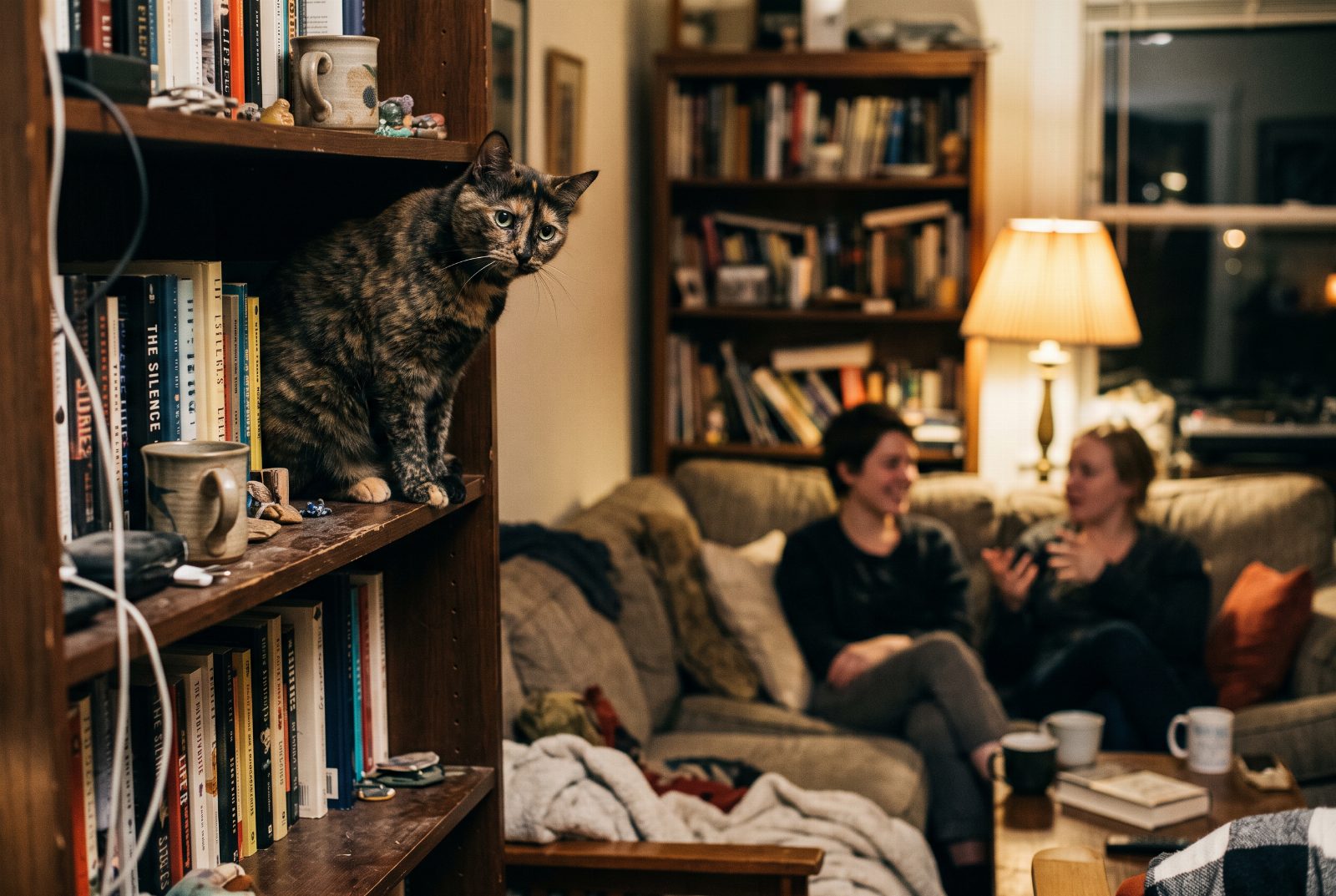
What actually happens is a chain of small things. How loud the guest is. How fast they move. Whether they walk straight at her and whether they stare. How they smell, of other animals for example. And the most important piece: how you react to them.
If you are unconsciously tense during a visit, your cat picks that up and adopts your assessment. She has no access to their character. She has access to yours.
That also explains the flipside plenty of people have seen. Why does the cat always head straight for the one person who does not like cats? Because that person ignores her, does not stare and does not approach. From a cat’s point of view, that is impeccable manners.
Why do cats really purr?
Cats do not purr only from contentment. The sound supports contact between mother and kittens and may later occur with closeness, expectation, uncertainty or strain. Read the rest of the body as well: posture, gaze, appetite and behaviour give purring its meaning.
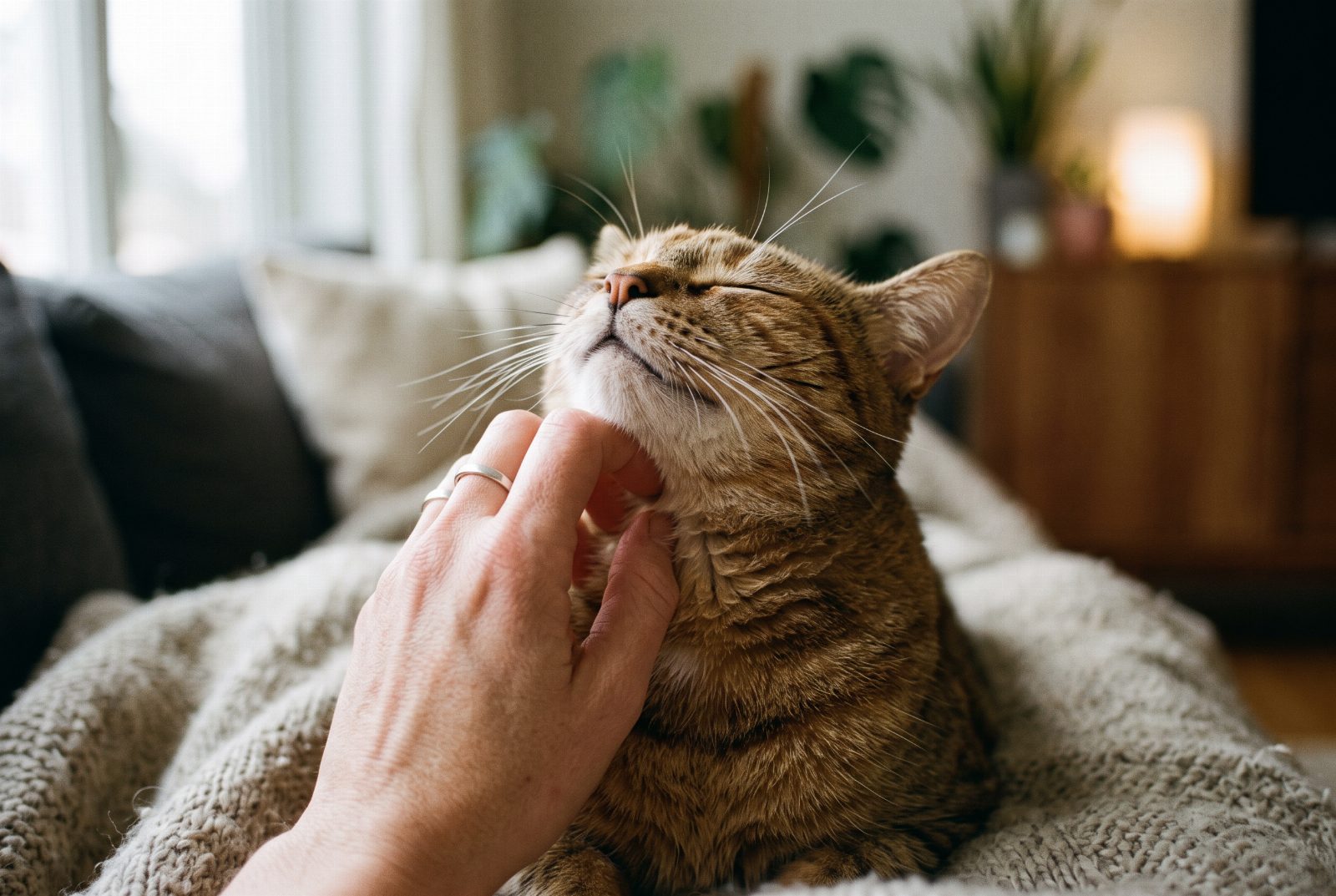
Purring is first and foremost communication, and it starts very early. Kittens purr while nursing and the mother purrs back. It is a contact signal: I am here, all is calm, stay with me.
It is produced in the larynx, on both the in-breath and the out-breath. The exact mechanism is still being researched. Measurements show a frequency range of roughly 25 to 150 hertz, with the bulk of it at the lower end, around 25 to 50 hertz. That is a deep vibration you can feel in your body, which is why a purring cat on your stomach feels the way it does.
Because that range overlaps with frequencies used therapeutically in human medicine, the idea came up that purring might have a healing effect. One thing to be clear about: that is a hypothesis, not an established fact. The frequency overlap is measurable. An effect has not been proven. Anyone reading about it should know the difference.
Why do cats purr when they are ill?
Purring can also occur in unpleasant situations, including fear, pain or a veterinary visit. A possible self-soothing role is discussed but not fully resolved. Purring is therefore not an all-clear. Reduced appetite, hiding or sensitivity to touch deserves veterinary attention.

Cats also purr when they are in pain, when they are frightened, at the vet, and in situations they find thoroughly unpleasant. The suspected function is self-soothing, a bit like a person under stress deliberately steadying their breathing.
IMPORTANT
In practice that means purring on its own is no proof that your cat is fine. If she is purring but also eating less, hiding, no longer grooming, reacting differently to touch or avoiding the litter tray, the purring is not the all-clear. Changes like that belong at the vet, not in a search engine.
The Purr With a Cry Hidden Inside
Did you know there are two different kinds of purr, and that one of them is a small masterpiece?
Researchers looked into why some purring gets under your skin immediately and some does not. The difference: the so-called solicitation purr (the purr a cat uses when she wants something, usually food) carries an extra, higher tone. That tone sits in a frequency range close to the cry of a human baby.
People who heard the recordings rated that purr as more urgent and less pleasant, including people who did not own a cat. So it is not an imagined effect.
Your cat has learned to use a signal your nervous system can barely ignore. She is not just reading you. She has studied you.
Why Doesn’t My Cat Purr, or Why Has She Stopped?
Some cats purr rarely or so quietly that vibration is noticed only by placing a hand on the chest. That says nothing about affection. A sudden change matters: if a cat that used to purr stops and also shows other unusual signs, arrange a veterinary examination.
Does coat colour say anything about character?
There is no reliable evidence for a general personality rule based on coat colour. Research mainly shows that people attach traits to colours. Behaviour develops through genetics, early experience, socialisation and daily life. Judge the individual cat, not her colour pattern or a familiar saying.
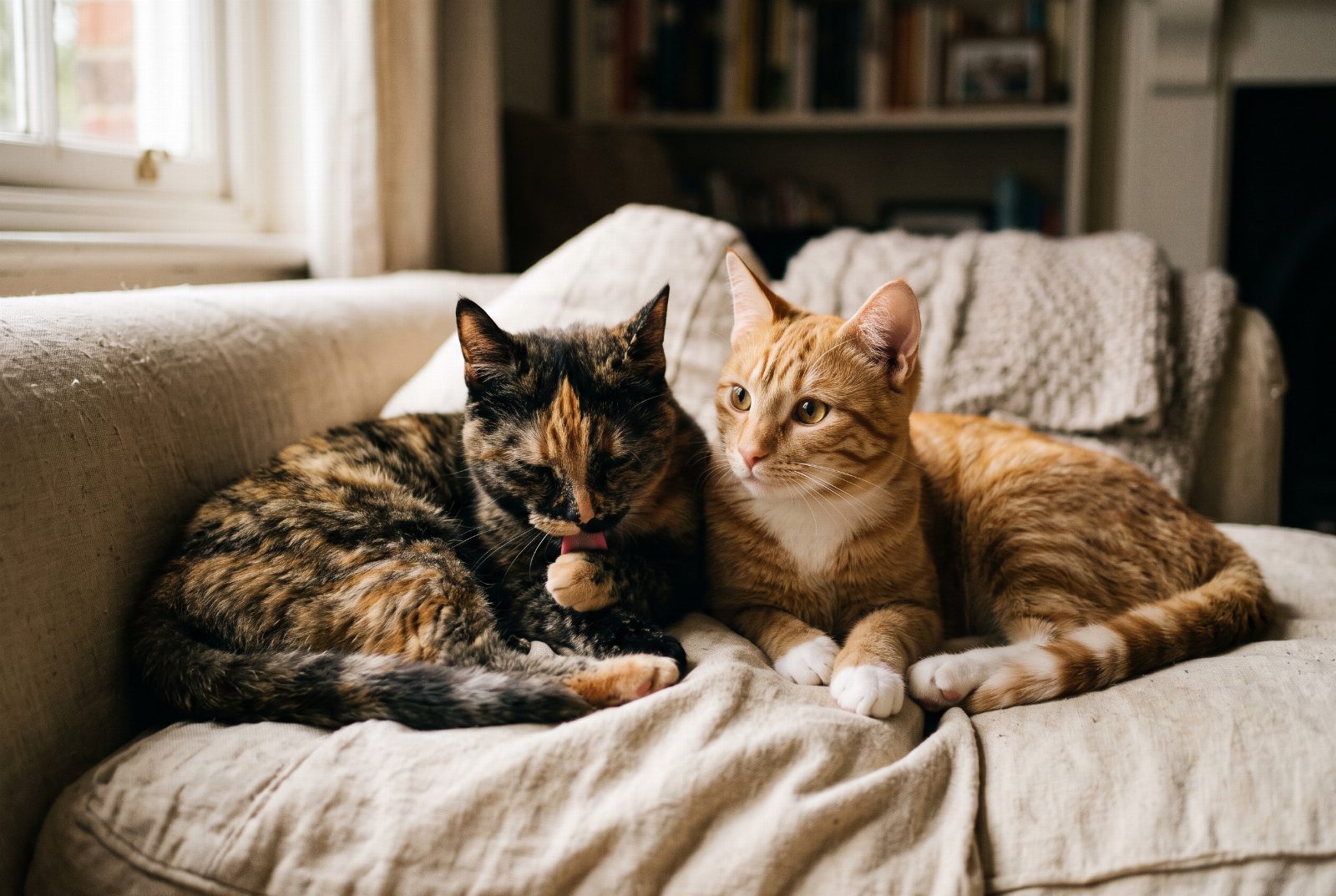
One thing in particular has been examined, and the result is more honest than expected. What can be measured reliably is not the cat’s character, but the human’s expectation.
In one survey, people credited ginger cats with the most friendliness, tricolour cats with the least tolerance, and white and tricolour cats with the most aloofness. Those attributions were stable and pronounced.
On the side of actual behaviour the picture is thin and contradictory. One owner survey found more frequently reported defensive reactions to handling in tortoiseshell, calico and black and white cats. Other studies found no link at all between coat colour and behaviour.
What does shape a cat’s character is well understood, and colour is not on the list. It is the genetics of the parents and the first weeks of life. In that window, contact with people counts for a great deal. After that, it comes down to what the cat has experienced.
The trouble with colour myths is that they can become self-fulfilling expectations. If you think a tricolour cat is going to be difficult, you approach her more cautiously, and she reacts to that caution.
Why Does Black Fur Sometimes Turn Brown?
Black fur can look temporarily rusty in strong sunlight because ultraviolet light alters the visible dark tone. Pigmentation may also appear lighter with age. A sudden, widespread or persistent colour change, especially with other unusual signs, should be assessed by a veterinarian.
Sunlight and viewing angle can make the effect much more obvious in photographs than indoors. Compare the coat in similar light before assuming that the colour itself has changed.
Important: A cause cannot be diagnosed from coat colour alone. Do not add supplements or change several parts of the diet based only on an online explanation.
What Folklore Still Claims About Cats
There is no evidence for any of what follows. We are writing it down anyway, because it belongs to the cat and because almost everyone believes a little bit of it.
Read it as a collection, not as advice.
- The cat cleanses the energy in the house and takes the negative onto herself.
- The black cat does not bring misfortune, she warns you about it. In that reading she is not a threat but an ally.
- The darker the coat, the more negativity she can absorb.
- Lighter cats draw prosperity into the house.
- If a stray cat stays with you, she chose the house, you did not choose her.
- The cat recognises the intentions of whoever walks in and shows you.
For the last one there is at least an explanation, and we covered it earlier: she is reading your reaction to the guest. For everything else the honest answer is that none of it can be measured. It is beautifully told, and it stays a story.
Two things we are deliberately leaving out. That purring heals people is a hypothesis and not a fact, and we separated that out above. And lines about what a person’s attitude to cats supposedly says about their character are pure invention. Those lines hurt people and they are not true, so they are not here.
When Your Cat’s Behaviour Suddenly Changes
There is an old idea that the cat is an indicator of how a person is doing. When life is going well, the cat is calm; when it is going badly, she becomes restless.
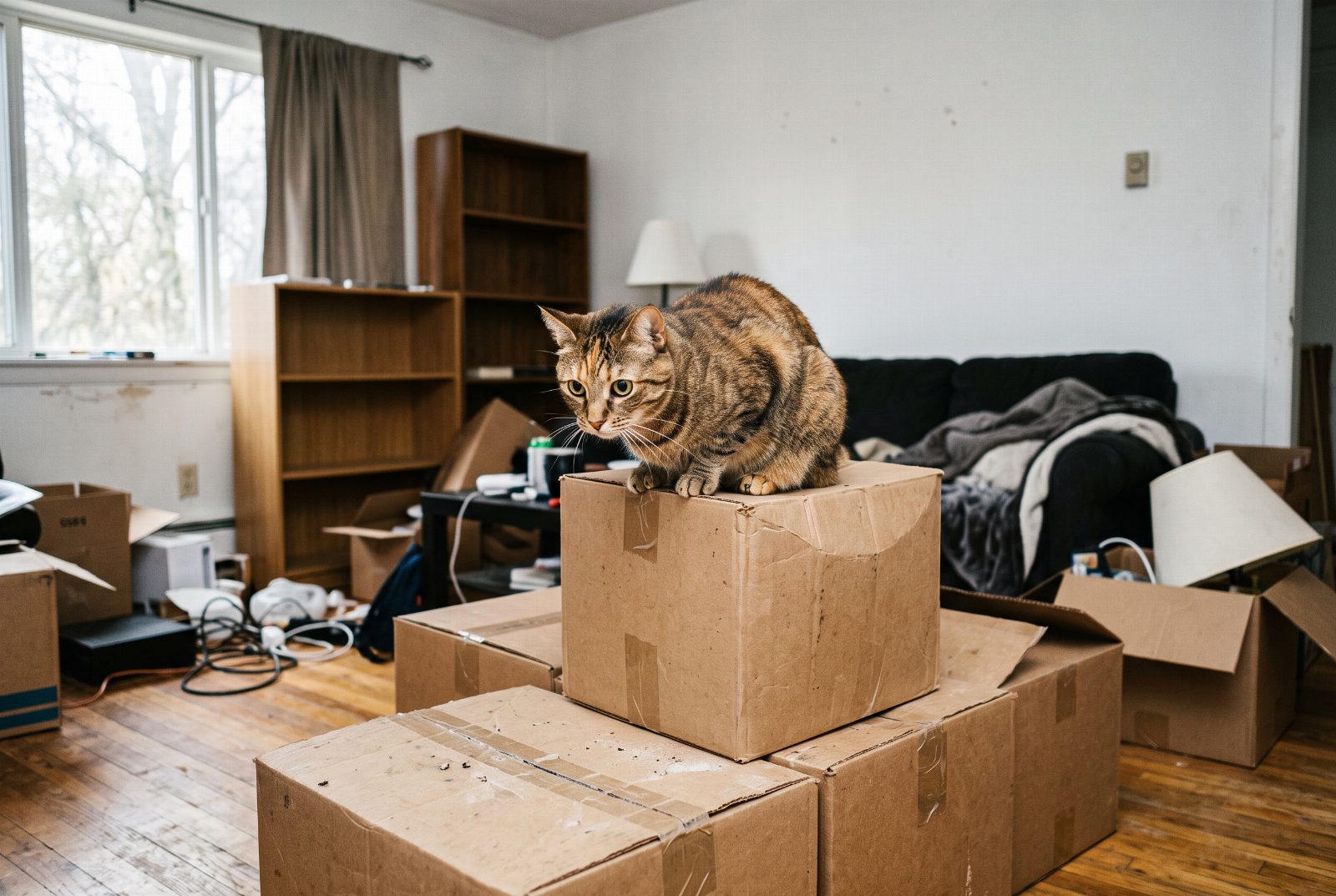
As a karma theory this is useless. As an observation it is fairly accurate, except the cause runs the other way round.
Cats depend heavily on predictability. Their wellbeing hangs on routine: the same feeding times, the same retreats, the same background noise, the same people. When a household is under stress, all of that changes at once. It gets louder, less regular, more rushed. Feeding slips. Doors slam. Nobody sits down in the evening.
Research on stress in cats shows it registers physically. In studies, cats with behavioural problems had measurably higher cortisol levels in their fur. Other research suggests that a dependable routine, hiding places and appropriate activity can reduce common signs of strain. Those include eating less, vomiting and avoiding the litter tray.
So your cat is not a karma indicator. She is a routine indicator. And because routine is the first thing to fall apart under stress, from the outside it looks like clairvoyance.
The helpful part is that the response can be simple and concrete. Fixed times. A spot where she is left alone. Raised places to lie down. And a feeding place where nothing else changes at the same time.
What the food bowl tells you about your cat
Food is where a lot of people first see the connection, because it is what you look at every day.
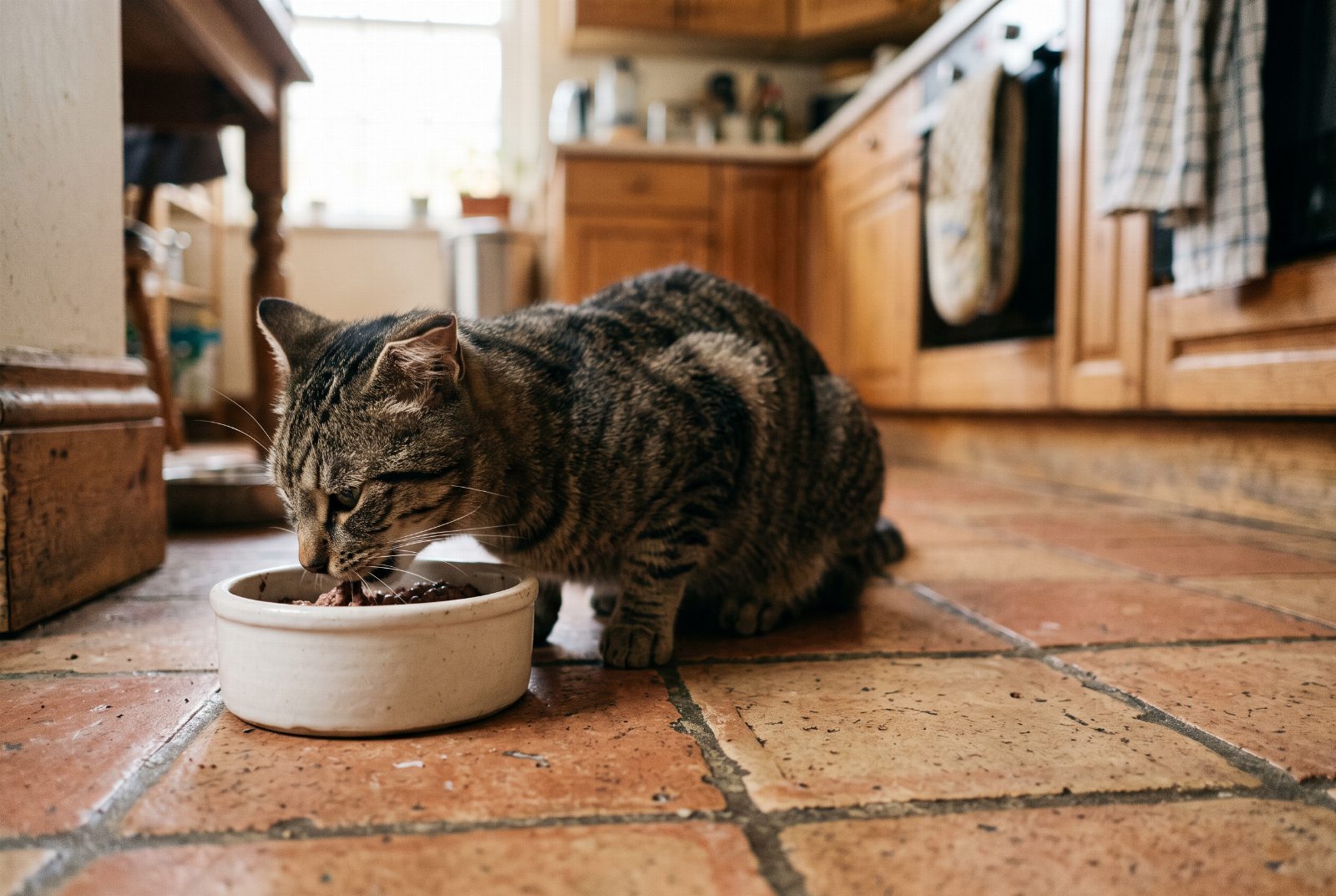
A cat who suddenly hesitates is a common topic. And because it looks so much like a mood in everyday life, it often gets written off as a character trait. She is just a diva.
Usually it is not a mood but one of a handful of very ordinary things: the temperature of the food. The texture. The smell, which is barely there when food is cold. The position of the bowl, too close to the litter tray or right in a walkway. A bowl that slides across the floor while she eats. Or a change of food that happened too fast.
And this is the one that is easiest to check: what is actually in the bowl. If you do not know exactly what is in there, you cannot rule out that an ingredient is the issue.
IMPORTANT
For anything that drags on, or comes together with hiding, vomiting or a change in weight, the rule stands: vet first, everything else after.
Transparency instead of magic: how we handle it at Canefelis
We built this piece from numbers and sources rather than nice-sounding claims. We do the same with the food.
Our cat line is called Cat’s. The chicken recipe declares 70% chicken breast, 8% chicken liver, 7% chicken heart and 5% egg, followed by vegetables, fruit and oils. Percentages replace vague collective terms.
The texture is soft-baked: prepared at 60 to 90 °C and then sterilised. The result is a soft texture with a noticeable aroma. This describes processing and sensory qualities. It is not a health outcome and not a promise about how an individual cat will eat.
No artificial gelling agents, no artificial attractants, no artificial colours, no artificial flavourings. In practical terms: 18 months shelf life without refrigeration.
What it says on the pack is what is inside. No magic formula, just a declaration you can read for yourself.
Four things to check first:
- Offer food at room temperature rather than straight from the fridge.
- Place the bowl somewhere quiet and stable, away from the litter tray.
- Observe texture and scent separately instead of changing everything at once.
- Make any transition slowly and begin with one change.
Frequently asked questions (FAQ)
Does my cat know that I am pregnant?
A cat cannot recognise pregnancy as a medical fact. She can notice changes in scent, posture, movement, sleep and daily routine. Some cats seek more contact, while others withdraw. Both reactions follow new signals; neither is a diagnosis nor a reliable prediction of pregnancy.
Can a cat sense when a person is dying?
There is no reliable evidence that cats predict death. During serious illness, scents, sounds, medication, visitors, routines and the atmosphere in a room all change. A cat may clearly respond to those changes. Her behaviour reflects perception, not a medical finding or a dependable prophecy.
Can cats cry?
Cats produce tears to protect the surface of the eye, but they do not cry visibly to express sadness as people do. They more often show emotion through behaviour, posture and voice. A watery, red or sticky eye needs veterinary attention, not a psychological interpretation.
Do cats dream?
Cats pass through sleep stages with rapid eye movements, small movements of the paws or ears and occasional sounds. These patterns correspond to dream sleep in other mammals. We cannot know what an individual cat experiences. The sleep stage is documented; the content of the dream is not.
Do black cats have a different personality?
Black cats do not have a personality determined by coat colour. Research mainly finds human expectations and only inconsistent behavioural results. Age, early experience, socialisation and daily life tell us much more. Meet the individual cat instead of using her colour as a personality test.
Why does my cat purr and then bite?
Purring and biting are not necessarily opposites. During petting, stimulation can build while purring continues. Watch for rippling skin, a lashing tail, ears turning back or a glance towards your hand. End contact earlier instead of treating the bite as a sudden personality change.
Do white cats bring good luck?
There is no evidence that white cats bring luck, just as black cats do not bring misfortune. Meanings change by region and period. Real consequences arise only through human expectations, including adoption choices. Colour itself does not influence the animal’s fate or value.
Which cat coat colour is the calmest?
No coat colour is reliably the calmest. Calmness and irritability depend on genetics, early experience, socialisation, environment and current condition. Anyone choosing a cat should observe the individual in several situations and ask carers about behaviour rather than selecting a supposedly calm colour.
Why does a cat knead with her paws?
Kneading begins when kittens nurse. Adult cats often show it on soft surfaces or in calm social situations. Its exact later function is not fully understood. Habit, comfort and scent marking may all contribute, so kneading is not a single, certain measure of emotion.
Why does a cat bring prey home?
Bringing prey home is part of normal hunting behaviour in cats that roam outdoors. The popular idea that she is giving a present or teaching a person is plausible but not proven. Home territory and a safe place to handle prey may also play an important role.
Why does a cat stare at the wall?
A cat often hears or sees something a person misses, such as a faint sound, an insect or moving light. That is not evidence of ghosts. New, persistent staring accompanied by disorientation, head pressing or another behaviour change should be checked promptly by a veterinarian.
Why does a cat sleep on you?
Warmth, a familiar scent, an elevated position and a sense of safety can explain why a cat sleeps on a person. The behaviour often suggests familiarity, but it is not a measurable proof of love. Some cats choose a blanket, armchair or quiet chair for the same reasons.
Related reading
Curious about the texture?
If you want to compare the soft-baked texture yourself, see the Canefelis trial packs for cats. The decision stays with you and your cat.
Sources
- Social referencing and cat-human communication (Animal Cognition)
- Coat colour and shelter outcomes (PMC)
- Coat colour, personality traits and the cat-owner relationship (PMC)
- Human perceptions of coat colour and cat personality (Anthrozoös)
- Black cats and time to adoption (The Open Veterinary Science Journal)
- The cry embedded within the purr (Current Biology)
- AAFP and ISFM Feline Environmental Needs Guidelines
- Free-roaming domestic cat predation study
- Coat colour and cat adoption outcomes
And your cat?
Over the next few days, observe one situation that used to seem mysterious and note sound, scent, routine and body language first. Magic often becomes precise observation. Share your cat’s story if you like, without turning one case into a general rule.