Dog and Cat Food Myths: 12 Misconceptions Fact-Checked


Have you ever heard that cats need a bowl of milk? That dry food brushes their teeth? That dogs are really wolves and should only eat meat? Or that you simply offer a fussy cat nothing else until it “eventually gives in and eats”?
Published: 19 October 2026
By the Canefelis editorial team · Updated: October 2026
You hear these lines at the dog park, in forums, at the pet shop checkout. Some sound like experience, some like common sense. And some have survived for decades, even though research has long shown something different.
If you sometimes wonder who to trust when it comes to pet food, you are not alone. Every guide contradicts the next, and in the end you are standing at the bowl simply wanting to get it right.
That is why we took twelve common myths about dog and cat food and checked each one against publicly verifiable sources: veterinary reference material, university clinics, studies and independent tests. For each myth, we give you a short answer, explain the evidence and offer a practical tip.
IMPORTANT
One thing first: this article does not replace an examination. If your pet seems unwell, stops eating or you are unsure, your veterinary practice is the right place to go.
The key points in 30 seconds
- Adult cats do not need cow’s milk. Water and a complete food cover their needs.
- Dry food does not brush teeth. Dental care and vet check-ups matter whatever type of food you choose.
- Dogs are no longer wolves. Their genome shows adaptations to a starch-rich diet.
- Never starve a cat to “train” it. If it stops eating, call your vet.
- Garlic does not belong in the bowl. Onion-family plants are toxic to dogs and cats.
- Price, advertising and shelf life say little. The label says more.
Myth 1: Can cats drink milk?
The picture is firmly lodged in our minds: cat, farmyard, saucer of milk. No wonder so many cat owners ask whether cats can drink milk.
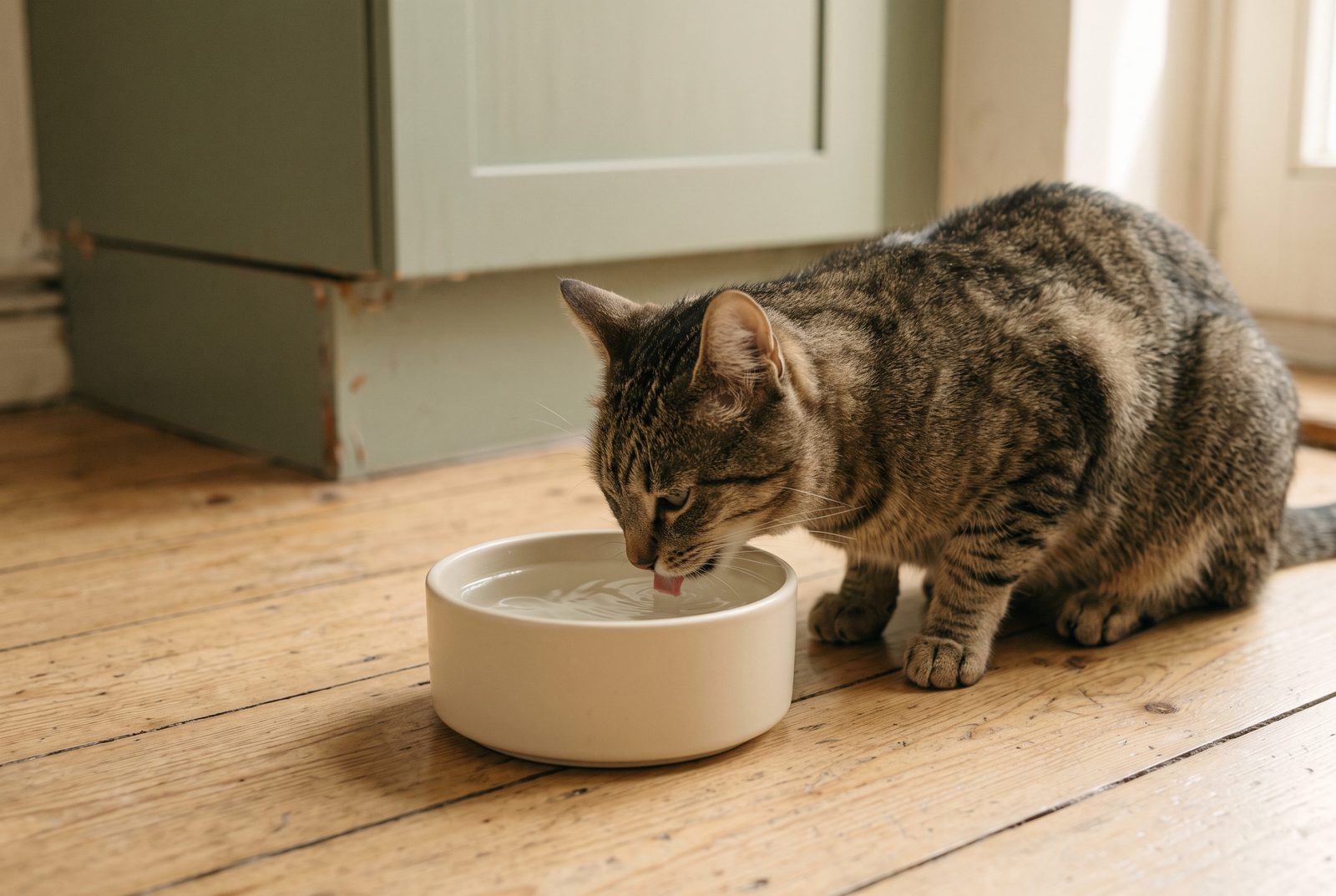
The short answer: they do not need it. Kittens produce the enzyme lactase, which breaks down milk sugar. Once they move on to solid food, they make less of it. Cow’s milk contains around 50 grams of lactose per kilogram, and that is exactly what many adult cats handle poorly.
Common symptoms include bloating, tummy ache or diarrhoea. Milk is not poisonous, but it is high in calories and is no substitute for water or a meal.
In practice: if you want to give your cat a treat, there is lactose-reduced cat milk. Even this should only be offered in small amounts as a treat. For drinking, water remains the go-to, ideally in several spots around your home.
Myth 2: Dry food cleans teeth
The logic sounds convincing: hard food crunches, so it scrubs teeth clean. For a long time even professionals believed this.

Today the veterinary school at Tufts University classes this assumption as a myth: both dry and wet food contribute to plaque build-up. Many dogs and cats barely chew their kibble and swallow it almost whole. There is no cleaning action when the kibble is swallowed whole.
There are, however, specially designed dental dry foods whose shape and structure are meant to reduce plaque mechanically. That is a property of that particular product, not of dry food in general.
In practice: whatever food you choose, regular brushing with pet toothpaste and a check at the annual exam help. Ask your vet how often to brush and which products to use.
Myth 3: Dogs are wolves and need nothing but meat
Anyone who sees a German Shepherd next to a wolf understands where this idea comes from. And yes, dog and wolf are close relatives. But many thousands of years of living alongside humans lie between them.
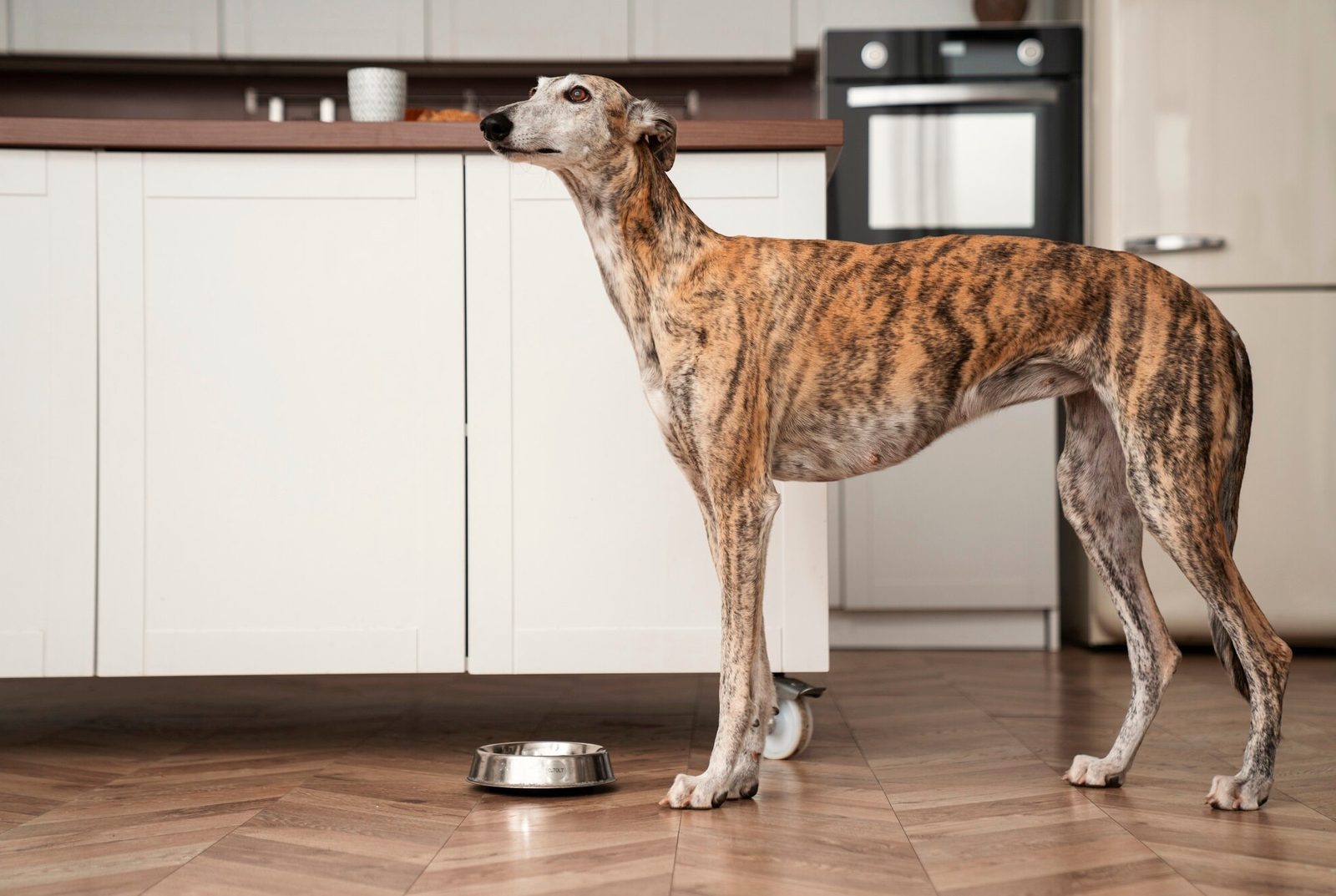
In 2013 a research team led by Erik Axelsson compared the genomes of 12 wolves and 60 dogs from 14 breeds. They found 36 regions where the two differ. Ten of them involve genes linked to breaking down starch.
The AMY2B gene, needed to produce amylase, stands out in particular. Dogs carry more copies of it, and in the pancreas it was around 28 times more active than in wolves. The researchers suggest that dogs adapted to the food they found near human settlements.
What it means: meat can play a central role in a dog’s bowl. But “meat only, like a wolf” is not a law of nature. What matters is that the food, as a complete feed, supplies every nutrient in the right amount. Plain muscle meat alone does not.
Myth 4: Grain in dog food is always harmful
“Grain in dog food, good or bad?” So many dog owners ask this that you might think there is a simple answer. There is not, and that is exactly the point.

The study from myth 3 shows that dogs can make much better use of starch than wolves. So grain is not automatically a worthless filler.
Whether it makes sense in a food depends on the amount, the type and the rest of the recipe. A food made mostly of grain with a low proportion of clearly identified meat ingredients is different from one in which grain plays a small part.
Grain-free is a recipe decision, not a health promise. Our own recipes are grain-free, and we say so in exactly that sense: as a description, not a verdict on other foods. If your dog has special needs, discuss the choice of food with your vet.
In practice: check which meat ingredients are listed, how much of each is included and what role grain plays in the recipe. That tells you more than a “with” or “without grain” label.
Myth 5: Dogs and cats should not always get the same food
We humans would get bored if every day brought the same meal. So we project that onto our pets and switch varieties the first time our pet leaves food in the bowl.
A good complete food, however, is designed to meet nutritional needs over the long term. Variety is therefore not a must.
With cats there is an extra point: in a veterinary reference book on feline nutrition, the authors describe how frequently switching varieties, brands and food types can disturb a cat’s natural ability to regulate its own intake. At the same time, a cat that only knows one texture may refuse something new at first.
In practice: both approaches can work. One regular variety your pet enjoys is perfectly fine. If you want variety, plan it: two or three familiar varieties in rotation, introduce new food slowly, and do not offer something else after every refusal. We describe what a planned rotation for cats can look like in Cat suddenly won’t eat its usual food.
Myth 6: You let a fussy cat go hungry until it eats
You often hear this advice for dogs, and for some otherwise healthy dogs, missing breakfast may have no ill effects. For cats, this advice is dangerous.
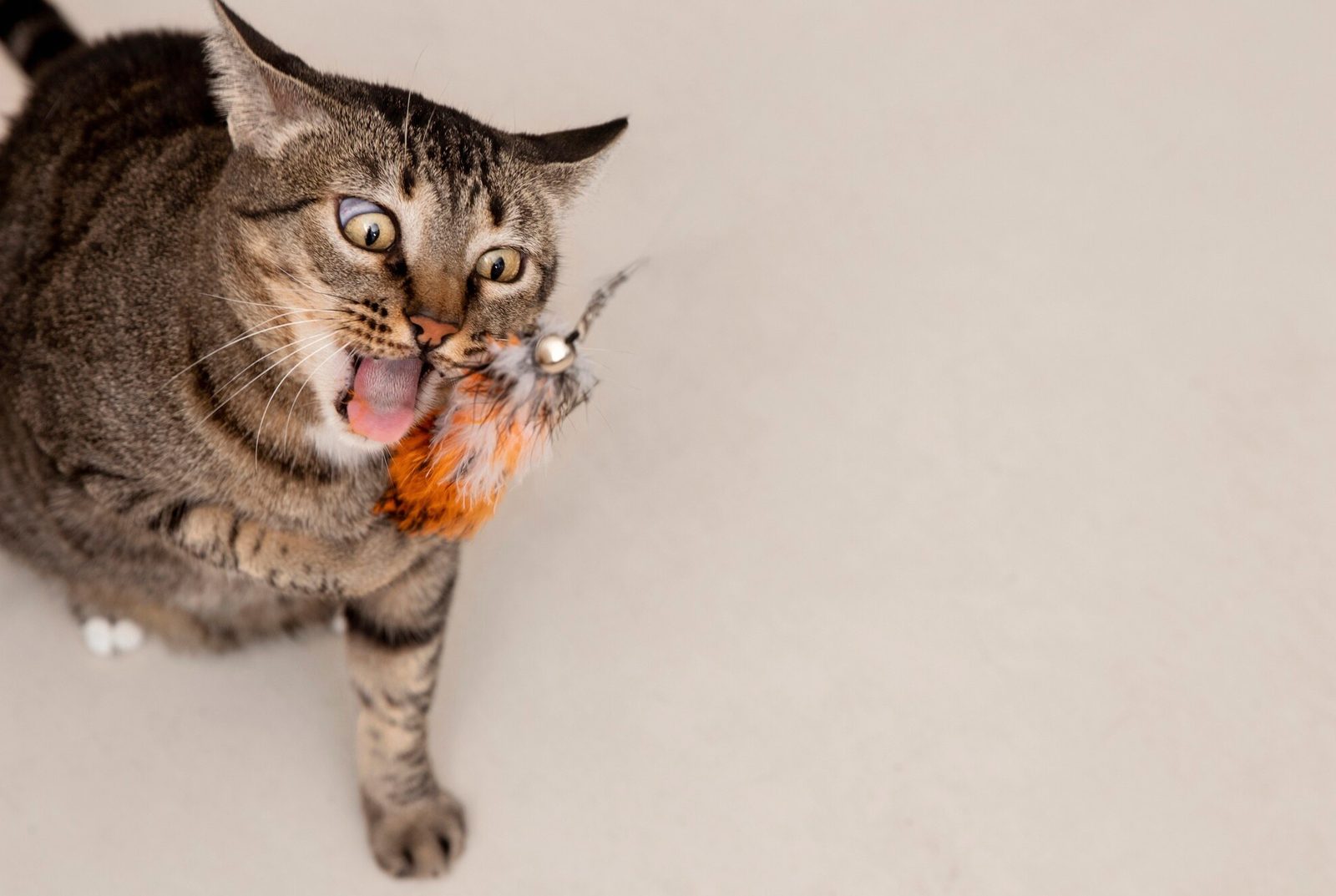
The College of Veterinary Medicine at the University of Illinois explains that cats that go without food for several days in a row can develop hepatic lipidosis, a fatty liver condition that can be life-threatening. Overweight cats are at particular risk. There is no fixed number of hours below which it is safe.
In practice: if your cat is barely eating or not eating at all, do not wait. Call your vet, and sooner if there is vomiting, pain, lethargy or the cat is overweight. Only once medical causes have been ruled out does it make sense to look at the bowl, smell and variety. You will find more in Cat not eating: causes, tips and when to see the vet.
Myth 7: Is expensive pet food automatically better?
Many people judge quality by price. That is only human, but for pet food it is an unreliable yardstick, in both directions.
A more recent example comes from Stiftung Warentest in April 2024: it tested 27 wet foods for adult cats. Sixteen received an overall rating of very good or good. Lower-priced products also performed well, while some expensive foods showed weaknesses.
That does not mean cheap is automatically good or expensive automatically bad. It only means that price alone does not answer the question. Price differences can reflect raw materials, processing, packaging, pack size or distribution.
In practice: look at what you can check. Does the pack say “complete feed”? Are the animal ingredients named with percentages? Does the feeding guide match your pet’s weight and age? And does your pet enjoy it? These four points tell you more than any price tag.
Myth 8: Long-life pet food is packed with preservatives
Many months without a fridge? There must be “chemicals” in there. Many people think so, and it is a fair question. With cans, trays and pouches, though, the answer usually lies elsewhere.
After sealing, these foods are heated in a retort: a pressure vessel that works much like an industrial pressure cooker. The aim is commercial sterility: microorganisms that would be dangerous or could multiply at room temperature are destroyed.
For that to last, the packaging must be hermetically sealed. A 2023 study describes this using cat food as the example. It also shows that pouches, trays and cans behave differently when heated.
So a long shelf life is first and foremost a matter of heat and packaging. The shelf life cannot tell you whether a food contains additives or which ones it contains. Check the label for that information.
In practice: read the “additives” section on the pack instead of drawing conclusions from the shelf life. And remember: once opened, that shelf life no longer applies. Opened food goes into the fridge, covered, and should be used up soon, as the manufacturer states on the pack.
Myth 9: Animal by-products are waste
The phrase sounds like scraps from the slaughterhouse floor. In fact “animal by-products” is a collective term from feed law, and it also covers parts that dogs and cats would deliberately eat in the wild: liver, heart, kidney, stomach.
An example from our own label: liver and heart count as by-products. Our chicken dog food lists 12 % chicken liver and 8 % chicken heart. So the problem is not the term, it is a lack of transparency. If the pack only says “meat and animal by-products” with no species or percentage given, you do not know what exactly is inside.
We explain in detail how to read a label in 30 seconds in Animal by-products in dog food: what they really mean.
In practice: check whether the species, the part and the percentage are on the pack. Then you know what ends up in the bowl, whatever the umbrella term is.
Myth 10: Garlic keeps ticks off dogs
A home remedy that keeps popping up in forums and comment sections: a little garlic in the food and the ticks will stay away. Here it is worth looking at the veterinary literature, because the risk is well documented.
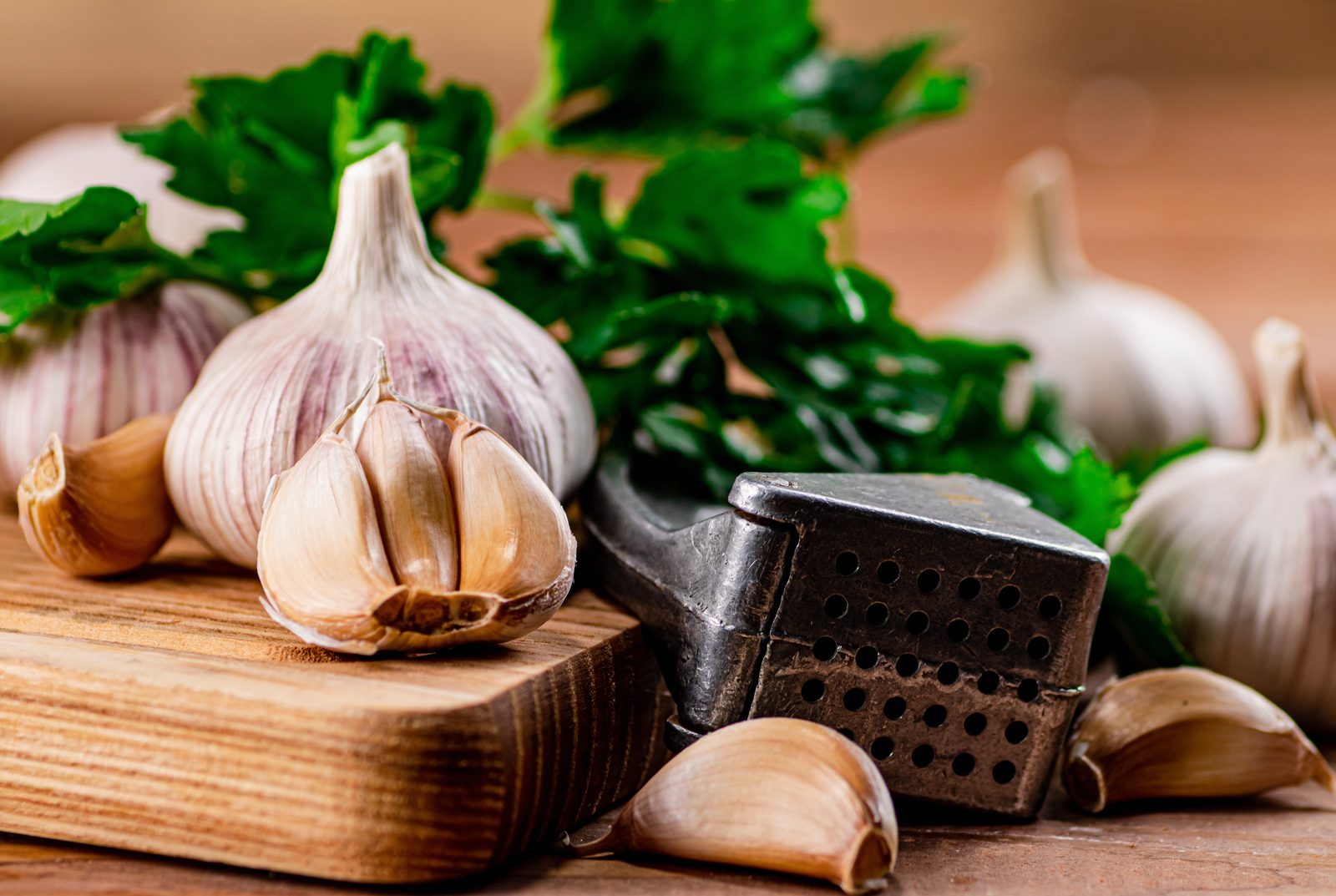
The MSD/Merck Veterinary Manual classes garlic and onions as toxic to animals. Their sulphur compounds damage red blood cells and can lead to what is known as Heinz body anaemia.
Garlic is considered roughly three to five times more potent than onion. Cats are the most sensitive, followed by dogs. The first signs may only appear three to five days after ingestion.
In practice: garlic, onions, leeks and chives do not belong in the bowl, not even “just a little” over a longer period. There are tested products for tick and flea protection. Which one suits your pet, its age and your routine is something to discuss with your vet. If your pet has eaten any of these, call the practice.
Myth 11: Cats do just as well on a vegan diet
More and more people follow a plant-based diet, and many wonder whether the same could apply to their pets. It is an understandable question, often asked out of love for animals.
In its current advice for owners, the British Veterinary Association does not recommend vegetarian or vegan diets for cats, citing their specific nutritional needs and unresolved questions about meeting those needs with plant-based ingredients.
For dogs, the BVA considers vegetarian or vegan diets possible in principle. Achieving nutritional balance is challenging, and long-term controlled studies are still needed. It advises choosing food labelled as complete and involving the veterinary team.
In practice: if you are thinking about a different way of feeding your pet, talk first to a vet with nutrition expertise. That applies to any major change, by the way, not just plant-based ones.
Why cats need so much meat is explained in our article on cats, meat and taurine.
Myth 12: Dog food is just as suitable for cats
In homes with both dogs and cats, it happens all the time: the cat helps itself from the dog’s bowl, and at some point you think it must be fine. After all, both are meat in a can or a pouch.

Dog food and cat food, however, are formulated for different animals. Cats are obligate carnivores, as the BVA stresses, and their food is matched to their needs, for example with taurine. That is why taurine appears in the analysis of our cat recipes, at a minimum of 0.15 %. Dog food is made for dogs and is not intended to feed a cat long term.
In practice: feed them separately, for example the cat on a raised spot and the dog on the floor, and clear bowls away after meals. If your cat regularly eats from the dog’s bowl, talk to your vet about its diet.
How separate feeding works day to day is covered in our article on dogs and cats in the same home.
How many dogs and cats live in German households?
According to the IVH and ZZF survey for 2025, Germany had 15.7 million cats and 10.0 million dogs. Cats lived in 24% of households and dogs in 20%. Overall, 43% of households had at least one pet. The figures, published in April 2026, came from a representative Skopos survey of 5,000 households.
That is a great many bowls filled every day, and a great many owners asking themselves the same questions. No wonder myths spread so quickly: every piece of advice gets passed on, including the advice that was never right.
How to assess dog and cat food without relying on myths
You do not need a degree in nutrition to assess the basics of a pet food. These questions will help you check the information on any pack:
- Is it a complete feed? Only then is it meant to cover daily needs on its own. Complementary feeds are not intended to be the sole diet.
- Are the animal ingredients named? Species, part and percentage tell you more than collective terms.
- Does it suit the species and life stage? Dog food for dogs, cat food for cats, and the age guidance should match your pet.
- Is there a feeding guide? It is a starting point. Weight and body shape show whether you need to adjust.
- What is listed under additives? There you will find vitamins, trace elements and other additives. What is not on the label should not be inferred from advertising or shelf life.
- Does your pet enjoy it? Even a perfect data sheet is of little use if the bowl stays full.
Frequently asked questions about pet food myths
Is wet food bad for teeth?
According to Tufts University, dry and wet food both contribute to plaque formation. So food type alone does not determine dental health. Dental care at home and regular vet check-ups matter more.
Can cats drink lactose-free milk or cat milk?
In small amounts, as an occasional treat, that can be fine as long as your cat tolerates it. Both contain calories and replace neither water nor a meal. If your cat has a medical condition or eats a special diet, ask your vet first.
How long can a cat go without eating?
There is no safe number of hours. Because cats can develop fatty liver after a few days without food, do not wait: if she is barely eating or not eating at all, call your vet, and straight away if there are warning signs or she is overweight.
Do I need to change my dog’s food regularly?
No. A complete food that your dog enjoys and on which he keeps a steady weight can be fed long term. If you want to switch, do it gradually over several days so your dog can get used to the new food.
How do I recognise a complete feed?
It is printed on the pack, usually next to the product name or the declaration: “complete feed for dogs” or “for cats”. If it says “complementary feed”, the product is not meant to be fed on its own.
How we handle this at Canefelis
We do not want to add to the myths. Here is what you can check for yourself on our packaging.
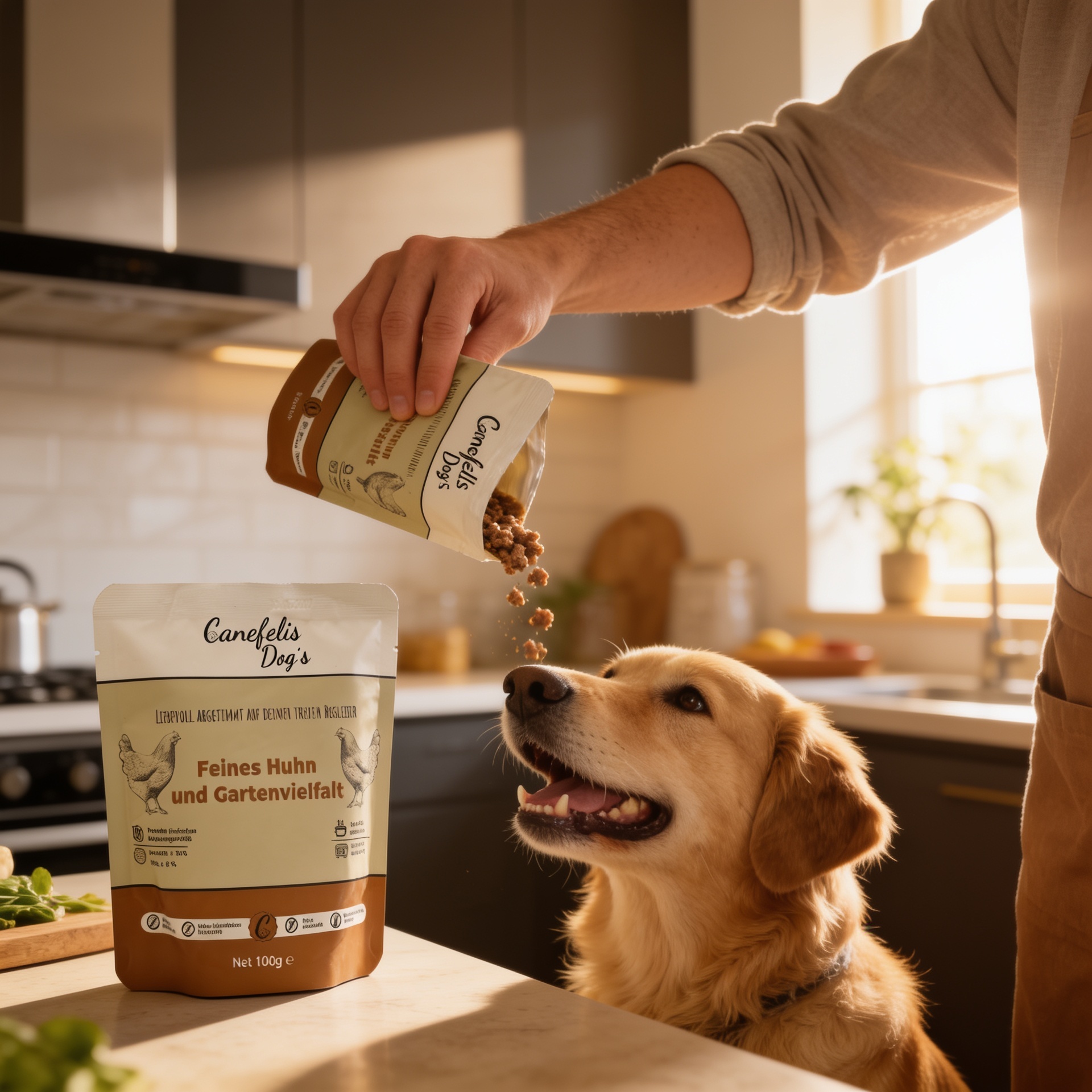
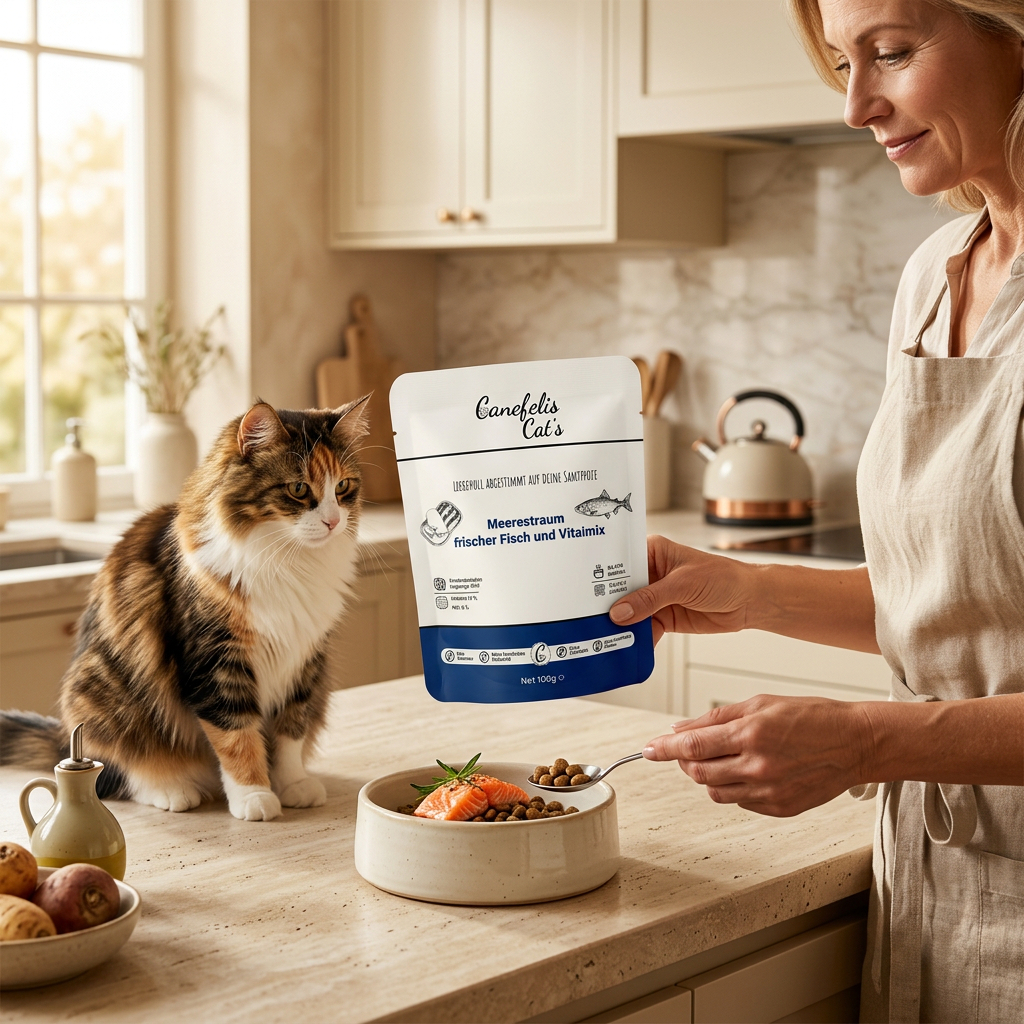
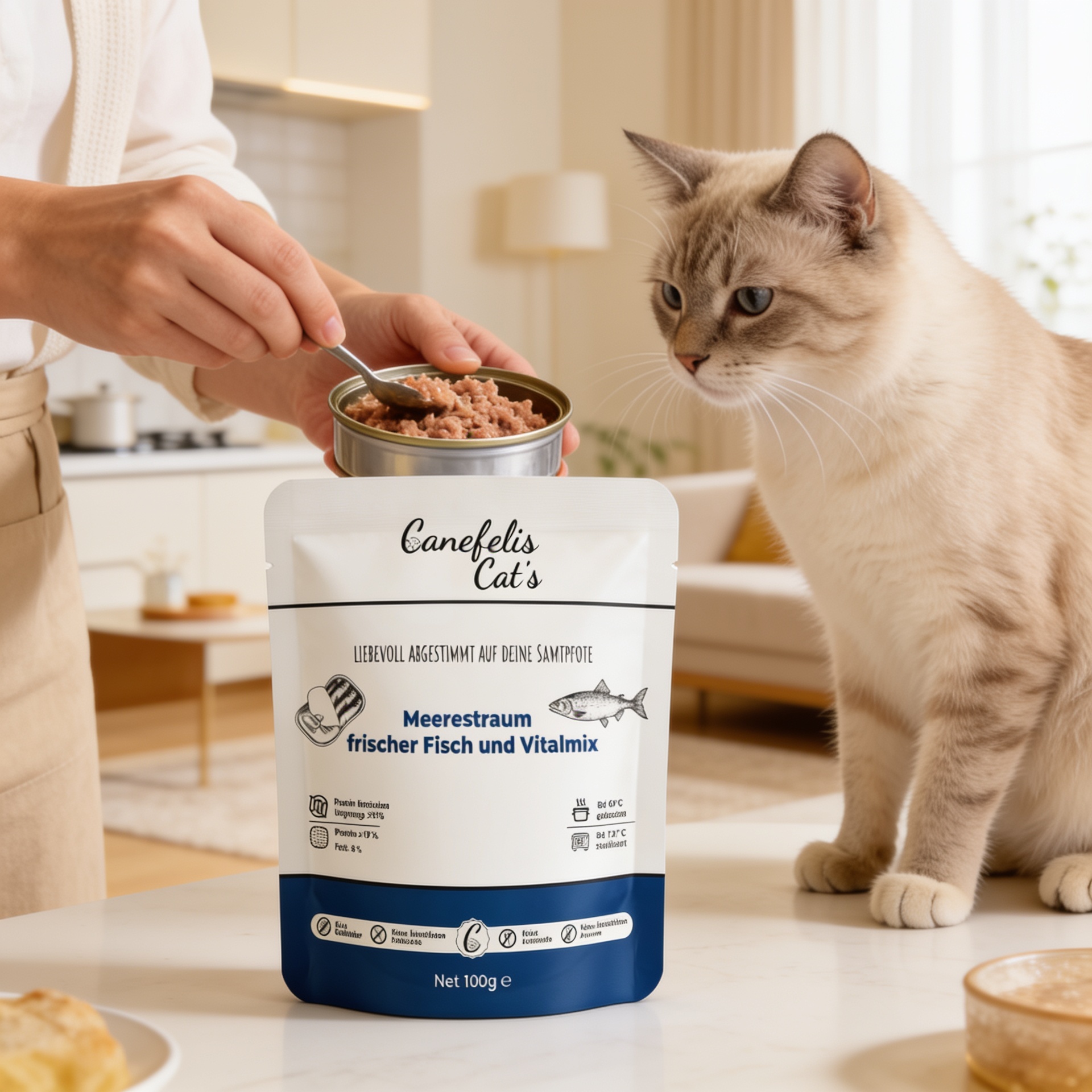
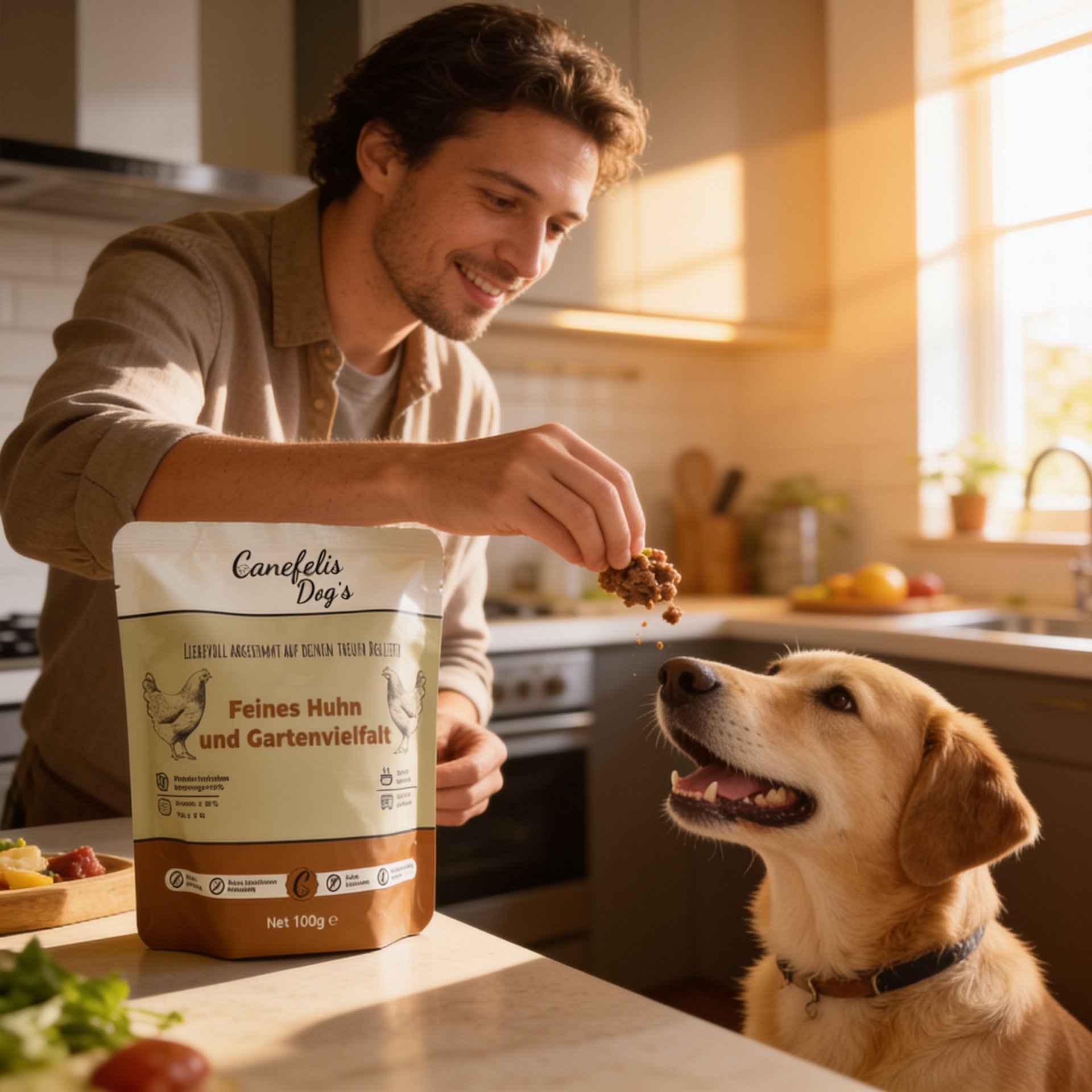
Our food is gently baked soft food for dogs and cats with a soft, moist texture, in 100 g pouches. All six recipes are declared as complete feeds for dogs or cats of all ages, and the animal ingredients are listed on the pack with percentages.
- Dog, chicken: 60 % chicken breast, 12 % chicken liver, 8 % chicken heart, 5 % egg.
- Dog, duck and chicken: 31 % duck breast and 29 % chicken breast, plus 12 % chicken liver, 8 % chicken heart, 5 % egg. So this variety contains chicken as well.
- Cat, chicken: 70 % chicken breast, 8 % chicken liver, 7 % chicken heart, 5 % egg, with taurine (minimum 0.15 %).
- Cat, fish and chicken: 40 % fish (salmon, sardine, mackerel, cod, bonito) and 30 % chicken breast. Chicken is included here too.
Liver and heart appear by name and percentage in our ingredient list, even though legally they count as by-products. Our recipes are grain-free by design; that is not a health promise. And the pouches keep for 18 months unopened. The additives are listed in full on the label of each variety.
Fancy trying it yourself?
Myths disappear fastest when you check for yourself. Our trial boxes contain 12 pouches of 100 g with all three varieties, so you can find out at your own pace what your pet enjoys.
For dogs: Dog Soft Food Trial Box · For cats: Cat Soft Food Trial Box
Free shipping to Austria and Germany on orders from €47.
P.S. When it comes to pet food, feel free to question “that’s how it’s always been done”. A look at the label takes 30 seconds.
Which myth have you heard?
Which of these claims have you heard at the vet's, from family or at the park? And is there a pet food myth we have not covered here? Tell us in the comments. We read everything and are happy to check yours too.
Read more