Why Cats Need So Much Meat: Carnivores and Taurine Explained Simply

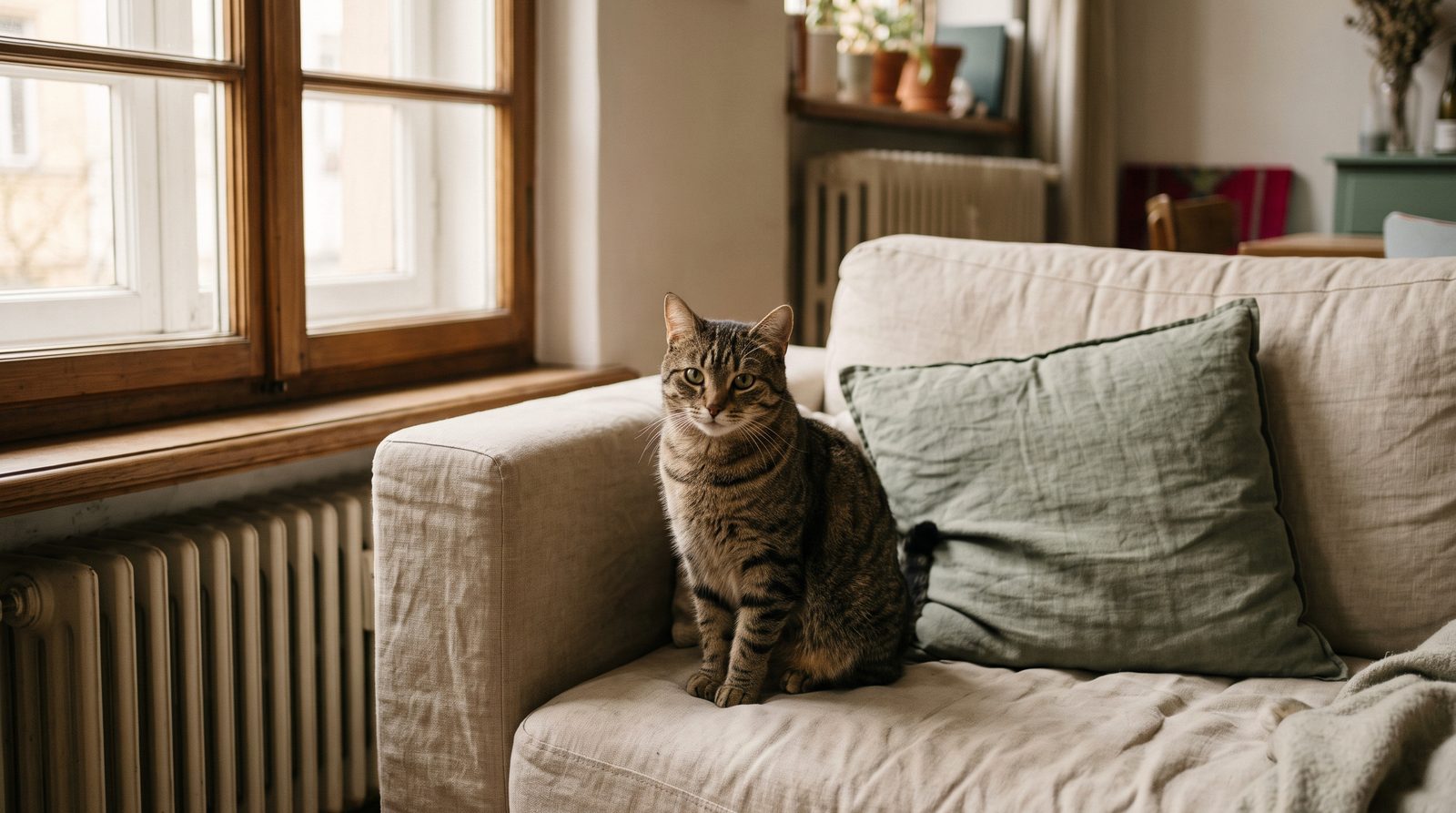
Have you ever wondered why your cat barely glances at the vegetables on your plate, yet suddenly sits right next to you when there is chicken? Why the word “taurine” appears somewhere on every pack of cat food? And whether “70 % meat” is actually a lot or just sounds good?
Published: 19 October 2026
By the Canefelis editorial team · Updated: October 2026
You are not the only cat owner asking these questions. Many cat owners stand in front of the shelf or scroll through online shops reading terms nobody really explains. Carnivore, crude protein, dry matter, taurine: it sounds like biology class, but these terms are easy to understand once you know the basic idea.
Our cat food pouches list the percentage of each animal ingredient and the minimum taurine content. Here, we explain what these figures mean and how to interpret them on any pet food label.
The short answer: cats are obligate carnivores. Their bodies are built to get certain nutrients ready-made from animal tissue. Taurine is the best known of these, but it is not the only reason meat matters so much in a cat’s bowl.
In this article you will learn what “obligate carnivore” really means, how cats' metabolism differs from dogs', why cats need taurine and where it is found. We will also show you how to read the meat content and the analytical constituents on the label, with a simple worked example.
The key points in 30 seconds
- Cats are obligate carnivores: they have to take in several nutrients ready-made from animal tissue.
- Cats can hardly make taurine themselves. Plants contain practically none, while heart, liver, meat and fish do.
- Besides taurine, arginine, arachidonic acid, vitamin A and niacin are among the cat’s special requirements.
- On the label, specific percentages per ingredient tell you more than general terms.
- Only give extra taurine or other supplements after talking to your vet.
Why do cats need meat? What “obligate carnivore” means
“Obligate” means roughly “compulsory”. An obligate carnivore is an animal whose nutrient needs can hardly be met without animal ingredients in its diet. That is the case for cats.
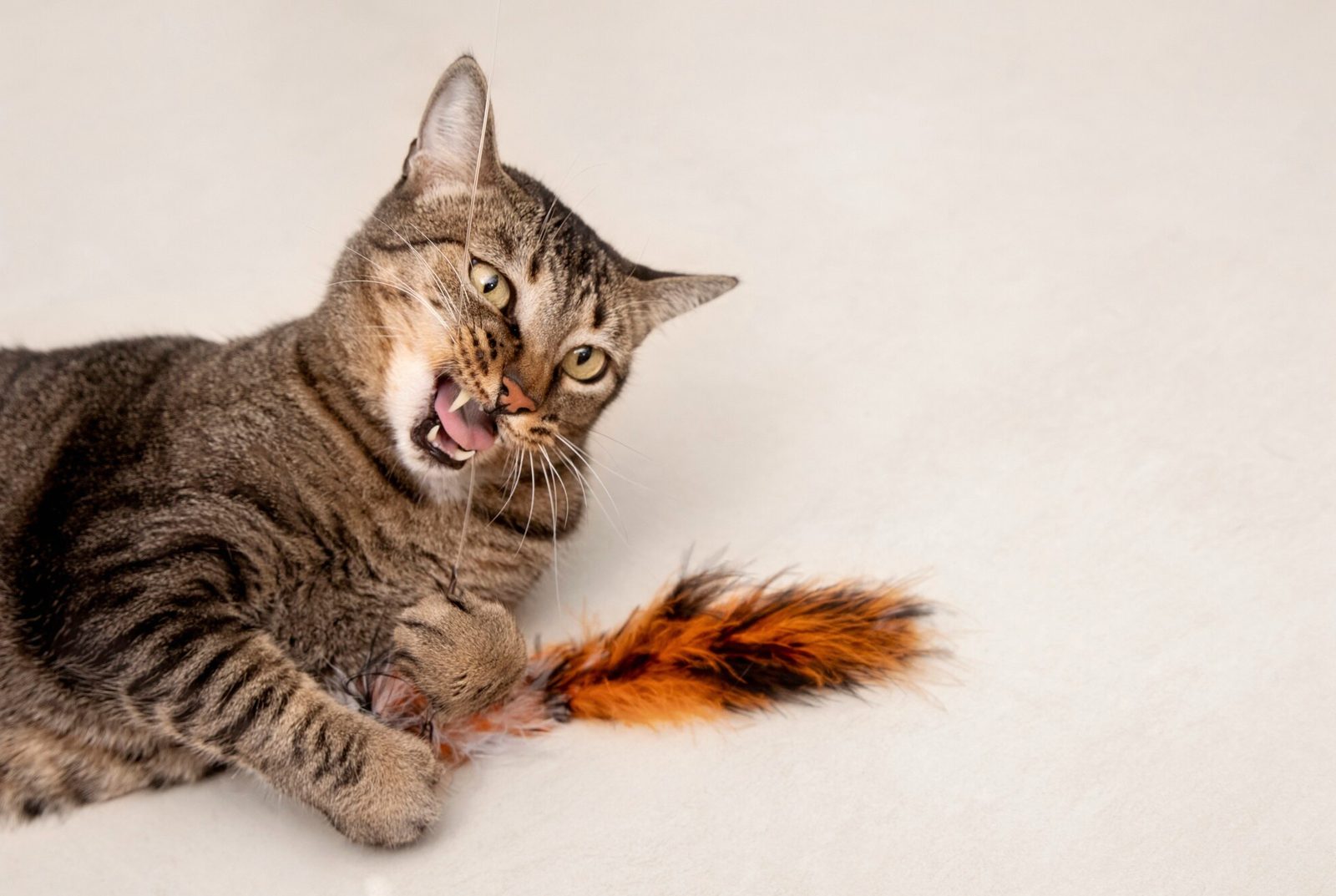
The reason lies in evolution. The ancestors of our house cats ate mainly small prey for a very long time. A daily diet of mice, birds or lizards supplies many nutrients in a form the body can use directly. The body no longer had to produce them itself, and some of these abilities faded over time.
Nutrition scientist James G. Morris described it this way in a widely cited 2002 review: the cat’s unusual nutrient requirements are an adaptation to a diet made up almost entirely of animal tissue. When we feed our cats, it is our responsibility to make sure their food supplies those nutrients.
That does not mean a cat should eat nothing but pure muscle meat. A mouse is not just muscle either. Prey includes organs such as liver and heart, fat, bones and stomach contents. It is exactly this mix that supplies the nutrients the cat’s body is tuned to.
Are cats omnivores or carnivores?
Many cat owners ask themselves this question. The answer is clear: cats are carnivores, while nutrition science tends to see dogs as omnivores with a liking for meat.
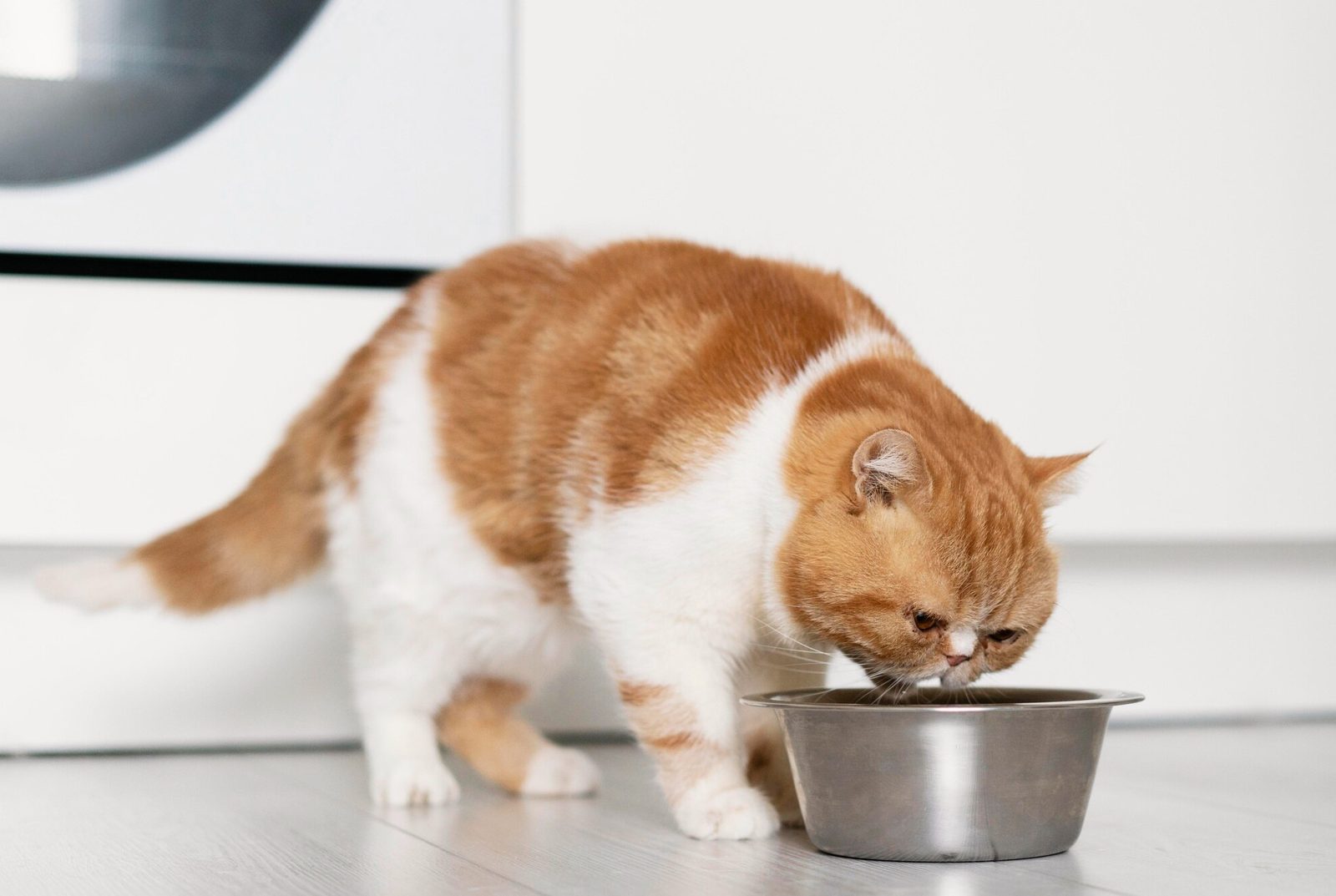
You can see it in their teeth. Cats have sharp fangs and molars that work more like scissors than millstones. Their teeth are better suited to slicing food than grinding it.
Does that mean cats cannot handle plants at all? No. Many cats nibble on grass, and small amounts of plant ingredients are found in most complete foods. Cats can use carbohydrates to a certain extent. Their metabolism, however, is built mainly around protein and fat as energy sources.
For cat owners, the practical takeaway is to check where the protein in the food comes from. Is animal protein clearly named at the top, or do plant ingredients dominate?
How cats' nutritional needs differ from dogs': protein, arginine, arachidonic acid, vitamin A and niacin
Anyone with a dog and a cat in the same home quickly notices that the two approach food very differently. Behind this behaviour are real differences in metabolism. Here are the most important ones, explained simply.
- Protein: cats need considerably more protein than dogs. Their body uses protein not only for building tissue but constantly for energy too, and it has little ability to reduce this use of protein when the diet contains less of it.
- Arginine: cats need this amino acid to process the nitrogen from protein. They can hardly make it themselves and, according to the literature, can be affected by even a single arginine-free meal. Dogs are far more tolerant here.
- Arachidonic acid: a fatty acid dogs can produce from linoleic acid. Cats largely lack the enzyme needed for this, so they have to get arachidonic acid from animal fat.
- Vitamin A: dogs can convert beta-carotene from carrots into vitamin A. Cats have very little ability to do this. They need ready-made vitamin A, as found in liver.
- Niacin: many animals make this B vitamin from the amino acid tryptophan. In cats this is not enough, so they have to get niacin from their food.
- Taurine: the best-known case. The next section is all about it.
The pattern is always the same: whatever prey already supplied, the cat stopped producing itself over the course of evolution. In the wild, that was no disadvantage. For feeding, this means a complete cat food must provide all these nutrients.
This is exactly why dog food is not a good long-term option for cats. It is designed for a different metabolism. An occasional bite from the dog’s bowl is usually no cause for concern, but as a regular meal it does not match what a cat needs.
What is taurine and why do cats need taurine?
Taurine is an organic compound usually counted among the amino acids. Unlike the familiar building blocks of protein, it is not built into proteins but is present in a free form in tissue. Particularly large amounts are found in the heart muscle and in the retina of the eye.
Taurine has several jobs in the body. One of them is forming bile acids, which play a role in processing fat. Dogs and humans can also use other building blocks for this. Cats rely almost entirely on taurine.
The key point: dogs can make taurine themselves from the amino acids methionine and cysteine. Cats can do so only to a very small extent. At the same time, they constantly lose taurine through bile acids. That is why taurine is considered an essential nutrient for cats, one they need to get regularly from their food.
IMPORTANT
A note for context: this is about nutrition knowledge, not a promise of healing. Taurine is a nutrient a cat needs, much as we need vitamin C. Questions about your cat’s health belong with your vet.
Where is taurine found? From mouse to bowl
Taurine is found almost exclusively in animal foods. Heart and liver are especially rich in it, followed by muscle meat, fish and seafood. Eggs and milk contain only small amounts. Plants contain practically none.
A whole mouse includes the heart and liver. In a home-prepared diet, however, an adequate taurine intake cannot be assessed from the choice of individual ingredients alone. The composition of the whole diet matters.
That is why many manufacturers add taurine to their foods, even when heart and liver are in the recipe. On the label you will find it under “additives” or among the analytical constituents, with a specific figure.
How taurine became a standard part of cat food
Taurine was discovered as early as 1827, in ox bile. That is where the name comes from, the Latin “taurus” for bull. It was only much later that researchers established that cats need it in their diet.
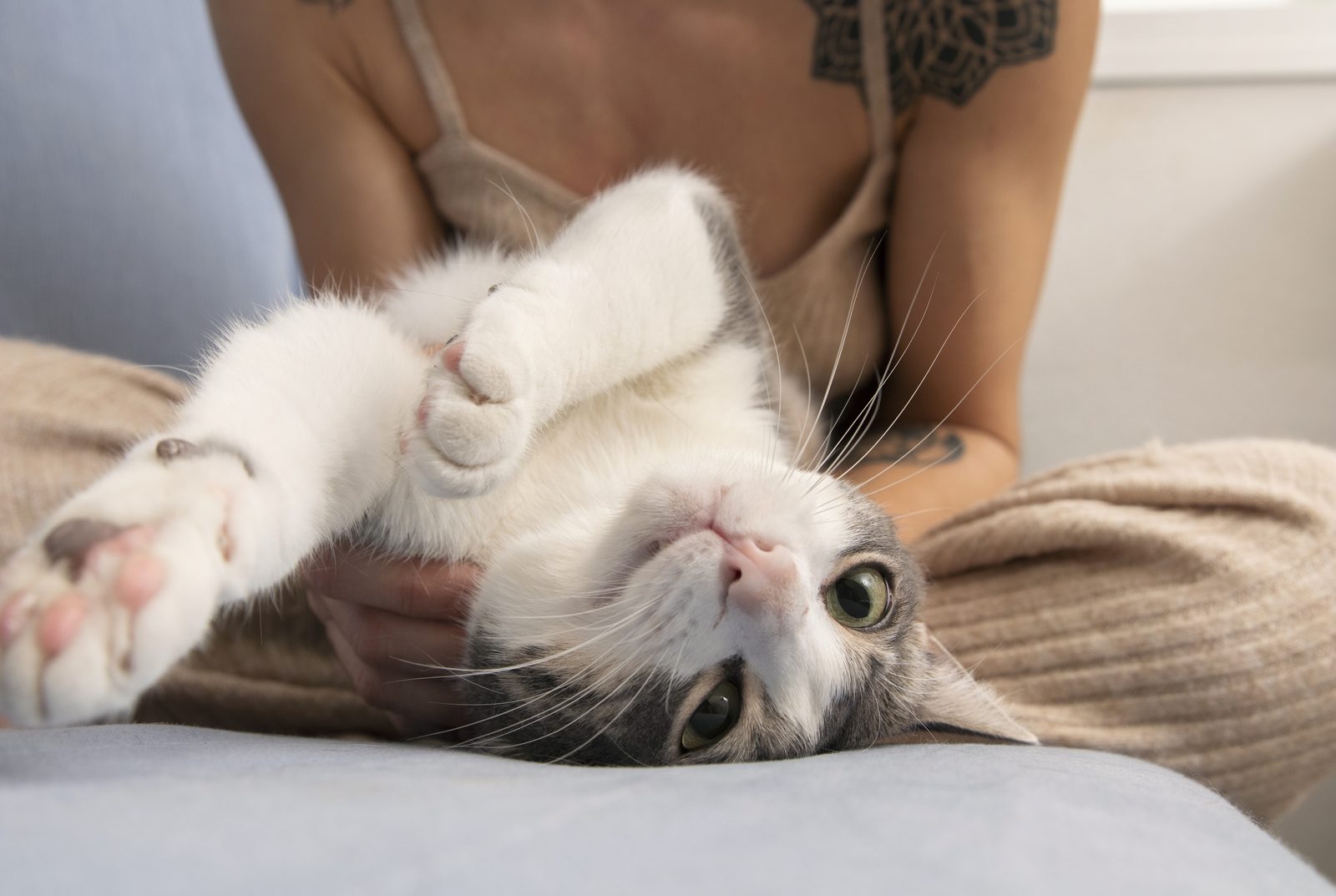
Research into feline nutrition has shown that an adequate taurine intake must be considered when formulating the daily diet. This does not establish any special effect of an individual food brand.
Taurine content is therefore considered when formulating a recipe. Taurine may also be added to the food.
For you, this means that food labelled as complete cat food is formulated to meet daily nutrient needs. Home-prepared diets should be checked by a veterinary nutritionist. Dog food is not a substitute for cat food.
How do you spot taurine on the label?
There are two places on a food pack where taurine can appear. The first is the “additives” or “nutritional additives” section. It lists which substances were deliberately added, often with an amount per kilogram.
The second place is the analytical constituents. Some manufacturers state taurine there as a percentage, for example “taurine min. 0.15 %”. That is a minimum value in the food as it comes out of the pouch, so including water.
What you do not need to do is rank foods by the highest taurine value. More is not automatically better here. What matters is that the food is labelled as a complete food for cats and meets their nutritional needs. If the pack says “complementary feed”, the food is not meant to be fed on its own.
Meat content in cat food: how to read the label
If cats need so much animal protein, the next question follows naturally: how can I tell how much meat is really in the food? Terms like “with chicken” or “rich in meat” do not help much. The ingredient list and the analytical constituents help far more.
Here is what you can look for:
- Percentage per ingredient: if every animal ingredient comes with a number, you can do the maths. “Chicken breast 70 %, chicken liver 8 %, chicken heart 7 %” tells you more than “meat and animal derivatives”.
- Order: ingredients are listed by weight. Whatever comes first is present in the largest amount.
- Clearly named species: “chicken”, “quail” or “salmon” is more precise than “poultry” or “fish and fish derivatives”.
- Organs are not a sign of poor quality: legally, liver and heart count as animal by-products. They supply taurine and vitamin A. We explain exactly what the term means in our article Animal by-products in dog food, and the principle applies to cat food just the same.
- Analytical constituents: crude protein, crude fat, crude fibre, crude ash and moisture appear on the pack as minimum or maximum values. You need to account for moisture content to compare them meaningfully.
Comparing crude protein properly: a worked example
A common mistake: “Food A has 30 % crude protein, food B only 19 %, so A contains more protein.” That is only true if both contain the same amount of water. A dry food often has around 10 % moisture, a soft food considerably more. The water dilutes the percentages.
The answer is dry matter: you take the water out of the calculation. The formula is simple: crude protein divided by (100 minus moisture), times 100.
Two hypothetical foods show why this matters. Food A has 30 % crude protein at 10 % moisture: 30 ÷ 90 × 100 gives roughly 33 % in the dry matter. Food B has only 10 % crude protein but 80 % moisture: 10 ÷ 20 × 100 gives 50 %. On the pack, A looks richer in protein, but B has more protein on a dry-matter basis. The water simply made the number on the label look smaller.
An example using the values on our cat pouches: crude protein at least 19 %, moisture at most 65 %. Mathematically, that gives 19 ÷ 35 × 100, so roughly 54 % crude protein in the dry matter.
Important: both numbers are declared minimum and maximum values, not measurements of a specific batch. The result is therefore a worked example that lets you compare different foods more fairly. Use the same calculation for every food you compare.
Is more meat in cat food always better?
Many people look specifically for food with over 90 % meat, in other words for the highest number. Understandable, but the number alone does not tell the whole story.
First, it depends on what “meat” means. Muscle meat, heart and liver supply different nutrients, and a cat needs the mix.
Second, a complete food has to provide all the necessary nutrients: vitamins, minerals and trace elements are part of it, however high the meat content. Third, it matters whether your cat actually likes eating the food. Even a perfect label is little use if the bowl stays full.
And the question from the beginning, whether “70 % meat” is a lot or just sounds good? It depends on what is behind the number: which ingredient, how much water and whether the food is complete. With the three points above and the worked example, you can judge that on any pack yourself.
If your cat suddenly eats less or not at all, take a look at our articles Cat not eating and Cat suddenly won’t eat its usual food. They also cover when it is time to call the vet.
Frequently asked questions about cats, meat and taurine
How much taurine does a cat need in its food?
The FEDIAF guidelines distinguish taurine recommendations by food type, life stage and energy intake. Food labelled as complete cat food is formulated to meet nutritional needs. If you prepare your cat’s meals yourself, have the plan checked by a veterinary nutrition professional.
Should I give my cat extra taurine?
If your cat eats a complete food, a supplement is usually not necessary. The situation may be different if you prepare your cat's food at home, feed raw (BARF) or your cat has special needs. In that case, only use taurine powders or pastes after talking to your vet, who will also decide on the right amount.
Can cats live on a vegetarian or vegan diet?
As obligate carnivores, cats depend on nutrients that occur naturally in animal tissue. Meat-free recipes have to supply all of these through additives, and mistakes often go unnoticed for a long time. If you are considering it, be sure to talk to your vet first.
Wet or dry food: what does it mean for taurine and water?
Both types of complete food can meet a cat's taurine needs, since manufacturers factor in processing. A big difference is water: wet food contains around 75 to 80 % moisture, dry food usually 12 % or less.
By nature, cats take in a lot of fluid from their prey. If you feed mostly dry food, pay special attention to always having water available.
Is taurine lost when cooking?
Cooking or frying times alone are not enough to calculate the taurine content of a meal. If you prepare food for your cat at home, a veterinary nutritionist should formulate the whole diet, including any supplements.
Why are cats not interested in sweet things?
It fits the picture of a true carnivore. In 2005, researchers showed that one of the genes for the sweet taste receptor does not work in cats. Cats therefore probably cannot taste sweetness at all. If your cat sniffs at a cake, she is more likely interested in the fat or the cream than in the sugar.
Do dogs need taurine in their food too?
Dogs can usually make taurine themselves from methionine and cysteine, so for them it is not considered an essential nutrient as it is for cats. If your vet recommends something different for your dog, follow that advice.
A label you can check yourself: how we do it at Canefelis
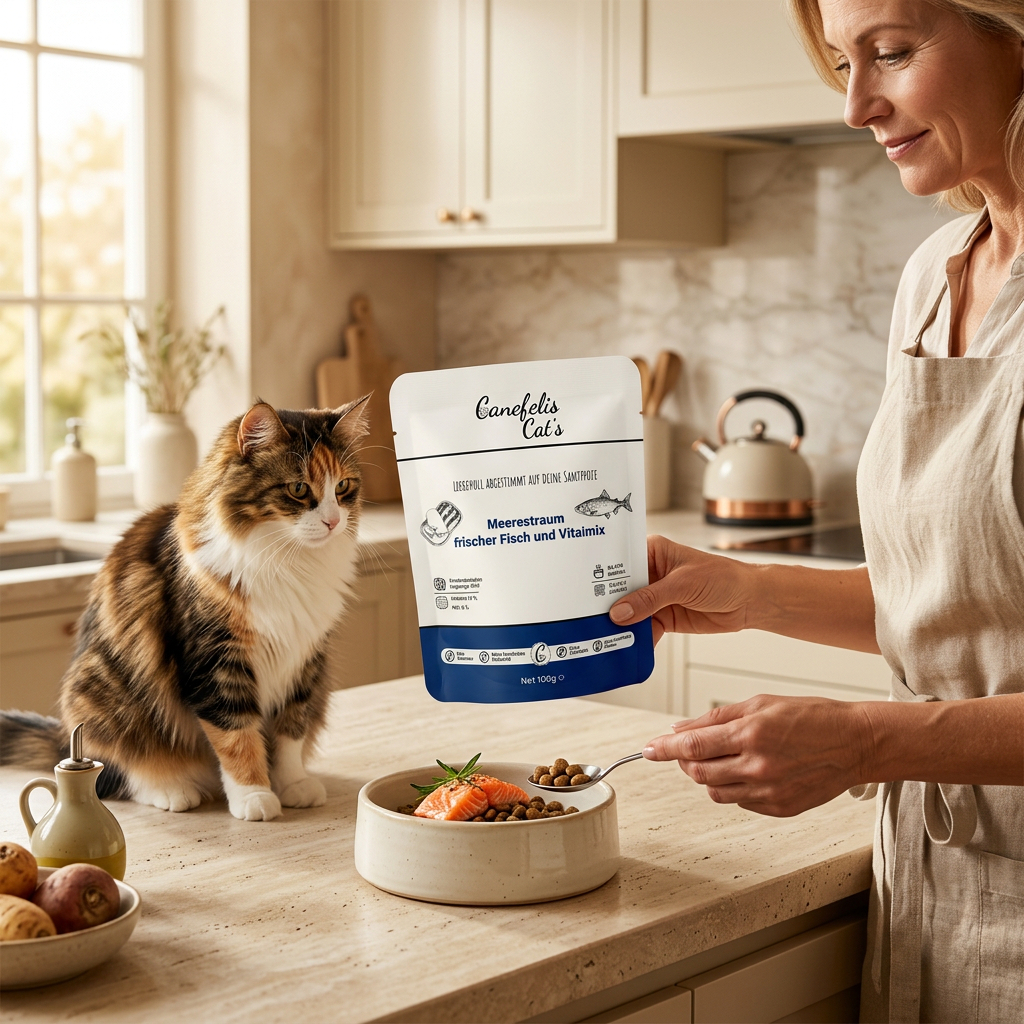
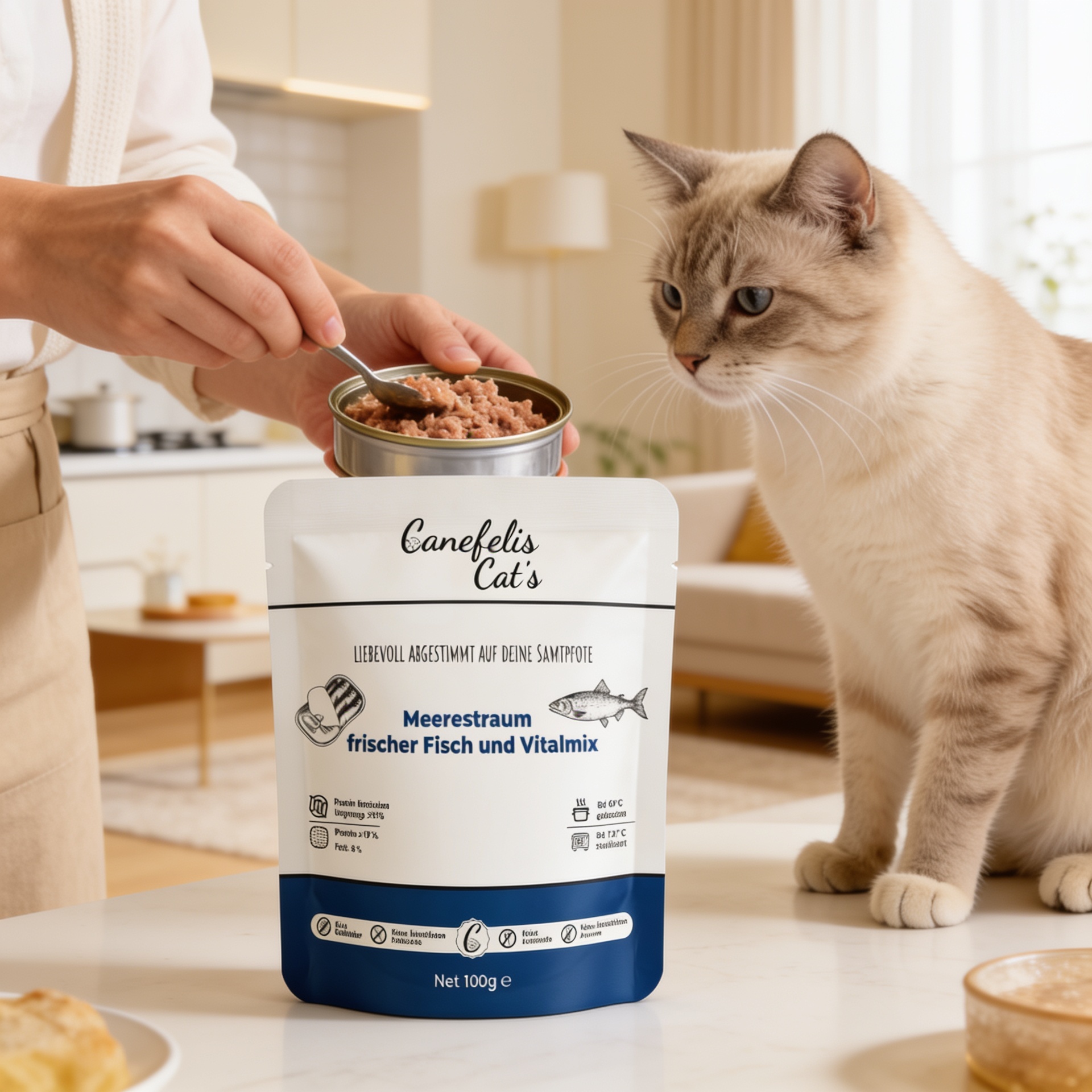
We make gently baked soft food for cats with a soft, moist texture, packed in 100 g pouches. We do not claim it does more than a food should. What we can do is show you exactly what is inside, so you can compare for yourself.
The three cat recipes according to the label:
| Recipe | Main animal ingredients |
|---|---|
| Chicken with Vegetables and Fruit | chicken breast 70 %, chicken liver 8 %, chicken heart 7 %, egg 5 % |
| Chicken & Quail with Vegetables | chicken breast 59 %, quail 11 %, chicken liver 8 %, chicken heart 7 %, egg 5 % |
| Fish & Chicken with Vegetables and Fruit | fish 40 % (salmon, sardine, mackerel, cod, bonito), chicken breast 30 %, chicken liver 8 %, chicken heart 7 %, egg 5 % |
We want to be clear about this: all three recipes contain chicken. The quail recipe and the fish recipe also contain chicken breast, chicken liver and chicken heart. If you want to avoid chicken, our cat food is not the right choice.
Other ingredients, used in small amounts, include peas, potatoes, carrots, cabbage, apple, linseed oil, fish oil and psyllium husks. All three recipes contain taurine (min. 0.15 %), as well as vitamins and trace elements, all listed in full on the pack.
The analytical constituents: crude protein at least 19 %, crude fat at least 8 %, crude fibre at most 2.6 %, crude ash at most 3 %, moisture at most 65 %. The pouch also states: 99 % protein of animal origin and 0 % grain. Unopened, each pouch keeps for 18 months.
You will find all recipes in our cat food range.
Want to try it yourself?
If you would like to try our recipes, the trial box is an easy way to start: 12 pouches of 100 g, all three cat recipes. That way you quickly find out which one your cat enjoys.
Go to the soft food trial box for cats. Free shipping to Austria and Germany on orders from €47.
P.S.: Next time you shop, turn the pack over and work out the dry matter once. After that, you will read labels differently.
What about your cat?
Does your cat steal chicken from your plate, or is she more of a picky eater? Have you ever worked out the dry matter on a label? Tell us in the comments. We read everything and are happy to answer questions.
Read more